Showing posts with label LGBTQ. Show all posts

Wednesday

do you want to be made well?


While knowledge and truth can be found anywhere, the kind of wisdom that leads to shalom is indigenous to the margins, among "the least," forgotten, and last. Those who know the way to peace and healing are the ones whose bodies, like Christ's, bear scars of others' war-making. Any who sit at empires' thrones feasting on its spoils cannot lead us into justice. The powerful offer up all sorts of expertise, but paths to peace they do not know.

Peacemaking is not a top-down operation, nor does its wisdom flow from center to margin. Peace is forged through conflict (not around), and the way to communal well-being and wholeness is paved with all sorts of interpersonal discomfort, tension, and sweat. Justice cannot roll until subtle and glaring hierarchies and broken systems are identified and ripped out. 

And that much-lauded (and alarmingly misunderstood) rebuilding work of crafting something just and new? It, too, is rooted firmly in Wisdom from the margins! The top and center are architects and upholders of injustice, well practiced in the status quo affirming appearance of peace, but rarely the presence of Kingdom-of-God shalom. Despisers of the critical work of dismantling oppressive systems are incapable of building anything truly new; they lack the empathy, will, and imagination to envision and create alternate paths. Resurrection wisdom lives at the margins, where Jesus anchored his own life and ministry alongside fishermen, lepers, women, peasants, the colonized, unqualified, Samaritans, sinners, and sick.

Peacemaking is the sort of messy work from which many would rather run, particularly those of us benefiting from How Things Are [Unjust]. Privileged voices are quick to paint protesters, critics, and marginalized bodies as disturbers of a peace which does not yet exist. It's a tricky game, with clear winners and losers, actual shalom being the latter.

But we can't hope to take part in fixing what's broken if we refuse to recognize the depths of what's wrong, and that requires going to the margins and sitting at the feet of people the majority are most accustomed to demonizing and writing off.

Until Christians hear and heed Wisdom from the margins, we actively stand in the way of peace, no matter how "gracious" and gentle our words or noble our intentions. Civility is a tool of empire, defined by power and expertly wielded against those who step out of line or refuse the terms of their faux-peace. The Kingdom of God springs up out of far deeper, more fertile soil--and on the backs of none.

So many Christian voices claim--and honestly desire--to be on the side of Jesus, justice, and peace, but shalom wholeness requires a radical de-centering of power, the active subversion of hierarchical systems, and a good bit more staying in our own lanes.

White people can't know the first thing about dismantling racism unless we are sitting at the feet of Black people and other people of color. Men who refuse to learn from and defer to women are incapable of leading anywhere just, no matter how impressive their CVs. Straight and cisgender opinions on homosexuality, marriage equality, transgender identity, and intersex bodies aren't nearly as helpful (or faithful) as many imagine. Edgy tattoos and good book reviews are clanging cymbals accompanied by discrediting survivors and sheltering powerful friends. People who are depressed, in recovery, marginalized, and hurting have a great deal to teach the rest of us about a God who is near to the brokenhearted, but we can't receive their wisdom if we're so busy blaming them for harshing our happy vibe.

It's not the healthy who need a doctor but the sick.

Many Christians are so accustomed to seeing ourselves as the healthy bringers of a gospel of wellness to a sin-sick world, but we're just as sick as anyone. (And we're not the doctor in this metaphor, either, particularly when our actions and neglect contribute to making our neighbors sick!) We trust a pallid gospel of go-to-heaven-when-you-die, but the "personal" Savior Christians claim inaugurates systemic, all-things-made-new, salvific work among and within our communities here and now. We are saved together for greater works than these.

Do you want to be made well? 

Well, do we? We've got to acknowledge the depth of sickness in our systems as much as our hearts, and we can't expect the same voices who taught us hierarchy and complacence to lead us out into wholeness. De-throne the experts: shalom-deep wisdom resides at the margins, with the suffering and bruised.

There, among the despised and rejected, we'll finally and fully encounter the Man of Sorrows we've long claimed to follow. And only there, together, will we be healed.

Sunday

were not our hearts burning?


Were not our hearts burning within us when the President preached Amazing Grace and Bree Newsome ascended that pole?
You come against me in hatred and oppression and violence; I come against you in the Name of God. This flag comes down TODAY.
One hundred fifty years from Juneteenth emancipation, six Black churches smolder, the dead in Charleston barely yet buried:
Clementa. Cynthia. Tywanza. Sharonda. Myra. Ethel. Susie. Daniel. DePayne.
And white Christians don sackcloth and ash, mourning marriage equality as churches burn, funeral hymns ring out, and wedding bells chime. They shall know we are Christians by our [lacking, lackluster, lukewarm neighbor-] love.
Bread unbroken
Stranger unwelcomed
Christ unrecognized
and we, unmoved, unblessed,
unborn.
Give us a garland instead of ash and hearts of flesh ablaze, beating and breaking and bound up together, let love fuel our work and our days.


but what are you FOR?


When you've got an analytical eye, folks may chastise your negativity. Why waste energies tearing down? Upright citizens less easily offended are actually contributing something worthwhile, so quit complaining and do something already!

Here's the thing, though: that binary is false. We can critique and create. We can do and do better still, and analysis is one of many tools that can move us forward. Gardens must be weeded if they are to flourish, and weeding is as much work as planting, watering, or harvesting the fruits of our labors. Each of us is uniquely gifted, and there is value in all sorts of service.

But a lack of concern for systemic injustice (especially that which hurts others and benefits me and mine) exhibits neither moral authority or Christ-like leadership. Despite the common refrain (often from those with most at stake in the status quo), critics and activists are not the reason Why We Can't Have Nice Things. Hierarchy and protected power, secrecy, greed, and oppression inhibit shalom far more than "the surfacing of tensions already present." A peace that does not yet exist cannot possibly be kept by silencing dissent, discouraging critical thought, or demonizing the hurting and those with eyes to see.

But what are the rabble-rousers, troublesome "mobs," and angry "social justice warriors" actually FOR, anyway?

The Fruits and Fire of the Spirit


We are for wholeness, hard truth, and a preferential option for the margins. We are for hospitality, boundaries, and diverse gifts. We are for accountable leadership, transparency, and learning. We are for knowing better and doing justice.

We are for indicting and exposing systems and patterns antithetical to the Kingdom of God. We're for assigning positive intent and showing our work. We are for taking responsibility for our own feelings and actions. We are for peacemaking, conflict, repentance, and seeing it through.

We are for the fruits and the fire of the Spirit. We are for testing everything and holding it up to the light. We are for one holy catholic and apostolic Church, the least, last, and lost.

We are for embodied faith, common prayer, and all things made new. We are for subverting power, dismantling empire, and love with roots, feet, and wings. We are for liberation and not losing heart or giving up. We are for belonging to one another and the good, hard, messy work of practicing resurrection and working out our salvation together.

"Our Struggle Is Not Against Flesh and Blood"


The sin in our systems cannot be addressed solely on an interpersonal level, and our best intentions do not exonerate us from participating in or benefiting from patterns favoring the powerful over the marginalized. When criticism and a desire for accountability and consistency are pathologized as ungracious and even satanic, it baptizes, protects, and reinforces power, which is, more often than not: white, monied, influential, male, cisgender, heterosexual, able-bodied, neurotypical, educated, etc. "Mob" voices deemed malignant, irrational, and un-Christlike overwhelmingly belong (not coincidentally) to women, people of color, survivors, LGBTQ people, and those experienced in mental illness. Widely parroted ideas about civility and grace sound pleasing but may not resemble the way of Jesus.

Healthy leadership is accountable, humble, and willing to learn, and criticism is integral to public discourse. Pretending that criticism and social media are the exclusive domain of trolls is disingenuous, silencing, and frankly, ridiculous coming from the mouths of those who have built sizable platforms on both.

Criticism is a discipline that does not exist in opposition to Christian discipleship. Neither people nor criticism is the enemy. Our systems are sick, and it'll take surgeons' scalpels; healing hands; faithful prayer; and good, hard, all-hands-on-deck work to make us whole.

also: 


Friday

violence in the snowy fields


The cover of the October issue of Harper's belongs to Rebecca Solnit's Silencing Women. (Her popular essay, Men Explain Things To Me, appears in a forthcoming book of the same name.) The article is behind a paywall, so I read it at the library and drove two towns over to get my own copy like the responsible literary citizen I can be.

The piece, about how women's testimony and voices are discredited, will be achingly familiar to many. It's worth a trip to the newsstand or library to read in full. Here's an excerpt:

Still, even now, when a woman says something uncomfortable about male misconduct, she is routinely portrayed as delusional, a malicious conspirator, a pathological liar, a whiner who doesn't recognize it's all in fun, or all of the above. The overkill of these responses recalls Freud's deployment of the joke about the broken kettle. A man accused by his neighbor of having returned a borrowed kettle damaged replies that he had returned it undamaged, it was already damaged when he borrowed it, and he had never borrowed it anyway. When a woman accuses a man and he or his defenders protest that much, she becomes that broken kettle. 
So many broken kettles. 

The story is always timely, but it seemed especially so to me having just read a thread over at David Hayward's Naked Pastor where a number of women spoke out about just that kind of treatment at the hands of leaders in the Emergent/emerging/progressive church movement. Nearly one month and eight hundred eighty-six one thousand seven comments later, that thread is still live, but I've not read much external commentary on it. A lot of people probably wish it would go away. It's unseemly, distracting. When such conflicts arise, it's worth examining who assumes the role of arbiter of What We Should Be Focusing On Instead and who are considered to be indecorous, un-Christlike troublemakers and unreliable narrators.

Of course, women are not alone in the experience of having their witness discredited or personhood diminished. Historically, it's even more common for people of color, (and women of color get it on multiple axes). Queer people and abuse survivors of all genders can similarly find their perspectives cast as untrustworthy against those who, across lines of power, are deemed less emotional and more objective, rational, and deserving of the benefit of the doubt by default.

It's exhausting. So many of the supposed "bad guys" and "good guys" behave in identical manners, which shouldn't surprise: no camp, theology, or political bent is immune from protected power, boys' clubs, gaslighting, mean girls, misogyny, bullying, or systemic violence. Across the board, our celebrity emperors have no clothes, but few even bat an eye.
It’s not just bros and jocks and finance dudes and yuppies and Christians and Republicans who are shitty to women. Being part of a counter-cultural or progressive community does not give you a free pass to be shitty to women without being called out on it. We need to hold our own communities to an even higher standard than we hold those in the opposition, we need to welcome criticism, and we to realize that the ones who call out shitty behavior in these communities are not the threat, but that those who protect it and shield it from criticism are. (On sexism, sexual assault and the threat of the ‘non-bro’
It lacks integrity, consistency, and frankly, faithfulness, if left-leaning Christians point fingers at abuses at Mars Hill or Sovereign Grace and then ignore the same destructive and marginalizing power dynamics repeated in our own backyards and communities. The sun still hasn't set on empire: it's hardly exclusive to the right, and "empire" is decidedly not a vague and lazy Jesus-juke available for leaders to wield against whichever criticism, tone, or perspective they don't appreciate (or find threatening to their own status).

Empire is present in every system privileging the humanity, word, and work of the powerful at the expense of "the least of these." Followers of the One who esteemed outcasts and undesirables, whose own inner circle offered nothing in the way of legitimacy or prestige, and who was ultimately executed by the literal Roman Empire colluding with religious authority should know better than to water down this most potent theological concept and critique of abusive, violent power.

We can do so much better, friends. Eyes to see. Ears to hear. Hands to heal. Feet to move: first to last, last to first.


Monday

is "progressive christianity" a useful distinction?


Some have gravitated away from labeling themselves "Christian," even if they've largely kept the faith. They just follow Jesus or perhaps consider themselves to be more spiritual than religious. Others add modifiers like "progressive" or "post-evangelical" to differentiate their beliefs from the faith of their fathers.

My faith has evolved, too, as I've grown, which I imagine is the case for most people. I've never felt drawn to exchange labels, but I recognize also that I hold the advantaged position of not bearing deep trauma wounds from the Church. I've been a Christian since I was a kid, and I'm still a Christian. I'm not particularly concerned that you'll think I'm one of those Christians. Christianity is diverse, and while I claim all Christians as kin, I speak only for myself.

Even when my bag was pinned with a "Who Would Jesus Bomb?" button and my feet marched in anti-war protests, I didn't consider myself a "progressive Christian." My politics were surely formed by my faith, but I considered myself as regular a Christian as anybody else at church, even if we voted or interpreted Scripture differently.

Recently I stumbled across a conversation on Twitter about the difference between "liberal" and "progressive" Christians/Christianity. One respondent offered that in the UK, progressive means "hyper liberal," but in the U.S. it seems to indicate "moderately liberal." The terminology can certainly function that way in the lexicon of politically centrist post-fundamentalist American Christian social media users, revealing in part why the label is so profoundly unhelpful.

For one thing, on the political spectrum, although progressive and liberal are sometimes used interchangeably, progressive does not functionally mean "moderately liberal." Political progressives are more radical and populist than liberals, rooted historically in the United States with activist movements for labor and education reform, environmental conservation, women's suffrage, and more. Liberal politicians are generally establishment Democrats, while progressive candidates are more likely to represent third parties and more radical reform platforms. Candidate Obama was fairly progressive, but he isn't a progressive president by any real stretch of the imagination. Progressives, who by definition seek greater progress, exist further to the political left of liberals.

Then there's the other problem, which Fred Clark explains: "The theological spectrum does not mirror the political spectrum for many, many reasons, the most important of which being that there is no such thing as the theological spectrum.'”

You could try telling that to third way-ers, whose theological identity seems to hinge on a unique ability to mediate the allegedly hostile, polar wastelands of progressive and conservative Christianity, but I don't think it would go over any better there than with the crowd who narrowly defines orthodoxy as whatever they believe, branding anyone and everything else "liberal," regardless of affiliation. (Adding to the confusion, liberal theology is a historical thing, but it's worlds apart from what many of us would recognize as postmodern or progressive Christianity.)

[Slacktivist]

I suspect that growing up in evangelical communities for whom "liberal" was akin to a Scarlet "L" pushes post-evangelicals to embrace "progressive" as their preferred signifier, but does progressive indicate anything meaningful in the context of popular theology?

Blogger Zach "Quitting the Progressive Christian Internet" Hoag "heartily embrace[s] the progressive label in its simplest definition of 'not conservative or fundamentalist evangelical.'” I agree with Zach that plenty of Christians claim the label as a static "not like those Christians" badge of distinction, but that sort of definition by negation is a weak baseline for an identity (particularly for one employed by a progressive Christian website). Failing to adequately define one's terms leads to the unhelpful lumping together of disparate theologies, people, and groups, as well as throwing other Christians under the bus in ways that aren't entirely charitable. Fundamentalism isn't interchangeable with evangelicalism, and I'm left wondering what exactly sets Hoag's or anyone else's faith apart as progressive? Comfort with mystery, tension, and questions? Affinity for liturgy? Less rigidity? More diversity? Social justice? I'm not pretending that I have no idea what folks mean when they say progressive Christianity, but many of those signposts aren't peculiar to Christians of a more progressive political bent. Christians across time and tradition practice a generous orthodoxy.

Hoag expresses concern for "unhealthy conversation...which so often wields the 'progressive' label as a weapon against anyone less 'progressive,'" seeming to argue that interrogating a self-identified progressive is off-limits: folks are progressive if they say they are, and any challenges to aim higher, go deeper, or listen more closely to the margins will be dismissed as unhealthy and even violent. That's certainly played out in his comment threads lately, where queer, female, and other dissenters have been deleted, blocked, and branded as toxic trolls while a sexist, sexually demeaning joke is left to stand. Also perplexing is the cake/too desire to don the progressive label, transcend it by exemplifying Jesus' own alleged "third way," and then grump should anyone point out that the left is more progressive than the center by definition.

If this absence of demonstrable belief and praxis is "Progressive Christianity," the theobrogians and conference circuit celebrities can have it. But unfortunately for them, progressive remains a political label. It doesn't function particularly well as personal branding, but as long as they claim to be progressive, we will ask to see their work:

  • Are they/(we) practically oriented toward progress, justice, reform, growth, and those existing at the margins?
  • Do they/(we) pass the mic, or do they/(we) prop up entrenched hierarchies further benefiting them/(our)selves?
  • Are learning, change, and liberation ongoing--or is a one-and-done changing of the mind on an issue good enough?
  • Are they/(we) truly affirming of racial, ethnic, economic, sexual, gender, body, and class diversity; Blackness; people of color; women and survivors; disabled and neurodivergent people; and gay, lesbian, bisexual, transgender, non-binary, intersex, asexual, and queer Christians and people--or is nicer, gentler discrimination sufficient "progress?"
  • Can they/(we) recognize and subvert oppressive power dynamics--even if personally implicated? Do they/(we) caution patience, civility, better humor, greater reason, and less emotion across lines of privilege, assuming faux-neutrality and a moral high ground they/(we) are perhaps not worthy of?

That's some of what I mean when I use the term progressive, and as long as we're operating from different definitions, worldviews, assumptions, and expectations, progressives are bound to conflict. More than that, we are talking past each other in essentially different languages, and the ways we communicate often reinforce rather than subvert established hierarchies and systemic injustice. Perhaps acknowledging that self-described progressives aren't on the same theological or political pages, easing up on the language of forced-teaming and hyperbolic war, is a step forward.

As a Christian whose politics are progressive and whose theology leans feminist and liberationist, I'm looking for a demonstrated commitment to justice, peace, and liberation among those who'd claim the progressive label, and I want to know that you believe in inequality. In Christian terminology, I'm seeking to loose the chains and break every yoke. I'm looking and working for repentance, resurrection, and all things made new. Yesterday's victories are worth celebrating, but the harvest is plentiful, and there's much yet to do. I name white supremacy and misogyny among the "powers and principalities" for which Christ died and over which he rose, and I admit that the rules are different according to privilege and power. There are times to listen and times to move our feet, and those most accustomed to leading are not necessarily best equipped for the work of birthing and building better paths forward

Progressives of faith, like all humans across time, won't agree on everything, but at the very least, might we affirm a commitment to ongoing growth as a community? Can we pin down a definition more meaningful and motivating than "Not X!" Can we interrogate whatever's standing in the way of our movements toward justice--even if it's u!--unafraid of "surfacing tensions already present" and seeking the sort of peace that's hard-won?

I dare say we'd be making progress.

Thursday

#FaithFeminisms: i believe in inequality


My feminism is (almost) done talking about equality.

If we take folks at their word, it would appear that almost everyone already believes in it. We wouldn’t dream of being racist, sexist, ableist, homophobic, or otherwise discriminatory. We know better. We’re good, welcoming people with the best intentions, but if Wisdom is truly proved right by her deeds, something is deeply amiss.

The Declaration of Independence asserted “all men are created equal,” but history proved white, Protestant, propertied men to be considerably more “equal” in practice, and not nearly enough has changed. “Separate but equal” Jim Crow segregation couldn’t demonstrate anything remotely resembling racial equality, and its shameful legacy persists to this day in our neighborhoods, schools, prisons, and halls of power.

Although certainly not analogous in degree or kind, plenty of Christians profess to believe in gender equality right alongside female submission and a hierarchy of roles in church and home. But more inclusive theologies and progressive politics aren’t a reliable indicator of functional equality either. If they were, certain denominations and communities would be that great Promised Land where none were limited by gender, skin color, ethnicity, status, sexuality, or any other difference, but we’re not there yet by a long shot. We’re not post-racial or post-feminist, yet we’re so eager for progress (and distance from those sorts of people) that we’re ever tempted to claim victories prematurely. Belief in equality of worth slowly morphs into the misconception that structural equality has already been functionally achieved. Mission Accomplished. We did it!

But a presence overlooked and ignored is not an absence. Those benefiting from the continued marginalization of others are in no place to proclaim how far we’ve come or what counts as harm, and despite all our believing in equality, white / male / heterosexual / cisgender / educated / Christian / conventionally attractive / upwardly mobile / neurotypical / able-bodied  perspectives and people are still honored as more “equal”. More authoritative. More respectable and civil. More rational, more trustworthy, more gracious, and more deserving. Gendered and racialized micro-aggressions exist perniciously (alongside other types), even if those in power fail to recognize them.
If a noble concept such as “equality” can be so consistently twisted to include or overlook subordination, propped up hierarchies, and a host of harmful and exclusionary practices and beliefs, perhaps it’s time to change the conversation.
I believe in inequality. I’m seeking confirmation that you believe in it, too – that you believe me – that together we may work to subvert hierarchies and birth another Way.
Can you acknowledge people as experts on their own lives and experience? If people of color, women, and  LGBTQ voices speak up about discrimination, will you write us off as bitter or toxic? Do you assume we’re overreacting, uneducated, or being emotional? Are we “playing the victim?”
If you hear talk of oppression or marginalization, do your eyes glaze? Are your lips quick with a sigh and rebuttal about the un-Christlike perils of “ideology” or “identity politics”? Do you really believe that your own perspective is somehow neutral and above the fray, unmarred by social location, assumption, or worldview? Is it possible that the benefits granted you by systems actively privileging your voice and value over others have compromised your ability to be objective or to assume the moral high ground?
Each of us is biased, formed by our own histories, identities, and experiences. I cannot leave my middle class whiteness at the door when I do theology or anything else, and each situation and perspective I encounter I experience as a woman.
But we can work to cultivate lenses oriented toward the margins and liberation. We can refuse to spiritualize Jesus’ declaration that he brings good news to the poor, recovery of sight for the blind, and freedom for prisoners and all who are oppressed. We can remember that Christ was executed by the state only to rise from the dead, making spectacle of its powers and principalities of violence and domination. We can listen to perspectives unlike our own, allowing ourselves to be softened and shaped by them. We can exercise compassion and humility, honoring Wisdom from the margins where Jesus pitched his tent and dwells.
WISDOM FROM THE MARGINS
Does not Wisdom call out?
Does not understanding raise her voice?
To you, O people, I cry:
set your hearts on me and listen
for my lips will speak the truth
Sophia is not voiceless.
Have we not listened? We are distracted.
Have we not heard? A gift not ours to give.
Incline your ear and understand:
amplify her voice. Her story is her own
but our salvation is entwined.
For those who find me find life
together and to the full.
------------

The conversations happening around #FaithFeminisms this week are tremendously challenging and inspiring. It's rare to find evangelical, liberal, and radical voices in one place, but it's happening here, and I'm excited to contribute my voice in print (and literally, as well). Spend some time on the site and consider linking up a post of your own. Good things are afoot.

[Archived here, here, and here.]

Friday

because white supremacy & misogyny are violence


Writing off what happened in Isla Vista as the work of a madman so unlike ourselves serves only to obscure the misogyny and white supremacy that undergirded Rodger's crimes, conveniently letting us off the hook for the ways those violences are rooted, too, in our own hearts and communities, on our watch. 
Unless we see and name the misogyny and white supremacy in our midst, we baptize a status quo that is inherently violent, hierarchical, and unjust.
Hold it up to the light. Make it visible. Make it change.


I've got a profile up at Micah Murray's site today on Elliot Rodger's racism, hatred of women, and related "aggrieved entitlement" as indicators of violence. Let's not lose this moment further (and needlessly) stigmatizing mental illness. Let's interrogate instead our cultures of violence and light a better way.

where are the women?


The Nines, a whitewashed, uber-masculine Christian leadership conference featuring just three female speakers (among more than hundred) had folks buzzing last week, particularly after popular author Rachel Held Evans engaged the organizer on Twitter about the lack of female voices. Later, Christianity Today characterized her as having a "meltdown" and gave organizer Todd Rhodes a few hundred words to explain that there were so few women (and people of color, presumably) because their theme was "what's working in churches."

Yup.

They then gave female speaker Christine Caine--who I've no doubt is a lovely person--another several hundred words to suggest that a lack of female accomplishment and God's will may account for the dearth of women in recognizable positions of Christian leadership:

I am grateful for the opportunity to serve leaders at conferences like The Nines, and I think the very fact that some one like me is included as a speaker in leadership conferences all over the world suggests that the church is very willing to hear from women as well as men…. 
The discussion over women's representation over conferences like The Nines is a valid one, and I think as more women step out and accomplish things empowered by the Holy Spirit then they will have something to contribute to helping leaders grow. 
I think you actually have to build something that is producing fruit whatever gender you are if you want to help others do the same. Your gender should not be what determines whether you speak at a conference, your gifts and fruit should be. I truly believe that if God has called you to do something, then God makes a way for you to do it... 
We have some work to do, but I think the medium is the message, and the fact that I am there lets women, minorities, and young people know that they can get there if there is where God wants them to be.

This is what is called internalized sexism. Having made it within an evangelicalism that frequently expresses itself as a boys' club, Caine seems to suggest that if her female peers had something to contribute, they'd be at that podium with her. To her credit, Caine later speaks of "holding open as many doors for young women as I can," but her set-up strengthens the locks on others by denying exclusionary or patriarchal factors at play in platform building and Christian leadership development practices.

Caine is clearly an accomplished and godly woman. Having someone like her as mentor would be a tremendous asset to anyone in ministry, male or female, and I applaud her for looking out for and grooming younger leaders coming up behind her, but we can't pretend that many of these metaphorical doors aren't bolted shut to women, people of color, LGBTQ Christians, and more.

Christianity Today glosses over the systemic injustices breeding the inequalities we see plainly with our eyes, brushing them under the rug and worse, implying they are sanctioned by God. Life isn't a meritocracy, exclusively rewarding those who work the hardest and those on whom God's favor rests. Those are hallmarks of the health-and-wealth prosperity gospel, not the the Kingdom of God, which as Jesus demonstrated is good news for the least, the last, and the lost.

Better Than Some!


This hasn't exactly been the Best Week Ever for women in evangelicalism, but it's got to be better on the progressive side of things, right?
Whenever I point out sexism within evangelicalism, men inevitably tell me that I should join the Mainline or perhaps a church like Roger Olsen's, where there's not even a hint patriarchyWhen I critique patriarchal strongholds in the emergent/progressive church, others try to shut me down with reminders that, "They're on our side", "He means well", or "X is so much worse", like somehow it's only okay to push back against conservative or fundamentalist expressions of Christianity.

But that's ridiculous. Inequality is systemic, and all of us--particularly leaders--should be able to meet a considerably higher standard than "We're better than Mark Driscoll on gender." It's not second-guessing anyone's motives to shine a light our praxis and ask, "Is this really the best we can do?" "Progressive" should never be a static label to wear but a shared commitment to actual Kingdom-oriented progress measurable in word and deed.

Some conservative Christians have entire theologies explaining why women shouldn't lead, so I don't expect anything different from their speaker rosters. I disagree but honestly, I respect when they put their cards on the table.

But progressive Christians whose theologies fully affirm women in leadership and who consider themselves to be LGBTQ affirming and wholly committed to racial justice cannot compare our record on women, LGBTQ equality, or race to The Gospel Coalition's. If we know better, we should be doing a lot better, not resting on fixed positions or past laurels. We can't be defined by what we're not, particularly when pushed on our own lack of representation and diversity, progressives may not react all that differently from conservatives. We shuffle our feet, mumble something reminiscent of "Bootstraps," and insist we tried our best or that it may not be practical to do it differently. (Or we cry my personal favorite, identity politics.)
Either all things are being made new among us, or they aren't. Are we incarnating Christ and reflecting resurrection in our ministries, or do we mirror the empire's deathly halls of protected power?

Diversity, equality, and justice have little to do with how good anyone's intentions are. Most of us generally mean well, and we still perpetuate oppression across theological and political spectrums. Sin manifests in our lives and systems despite our best intentions, and if we're honest, even our intentions aren't always so pure, because we're frequently lazy and selfish. (Just me?) It is absolutely a beneficial community practice to assume positive intent in one another, but good intent won't cover (or atone for) a multitude of personal or social sins--or erase the power dynamics at play when people of certain races, genders, or sexual orientations are marginalized in overt and subtle ways. (We exclude others, too, like those considered to be less sure, strong, educated, beautiful, married, wealthy, healthy, or righteous.)

Love covers, yes--and it does the work!--but good intentions alone are pretty useless, particularly conceived as a sort of "get out of jail free" card excusing us from taking responsibility for oppressive, marginalizing action or apathetic complacency. The questions that matter most are not, "What was the intent?" or "Do they believe X?" but "How well are we walking this out?" and "What steps can we practically take to do this better?"

A popular eighties cartoon professed that knowing is half the battle, but knowing is just a baby step out the door. Knowing better stuff rarely made me more like Jesus, and neither kindness nor shalom has much to do with simply knowing the right thing.

Walking it out is the hard and hallowed, messy part--the worthy work of cultivating something better, nourishing it together, and helping justice to roll down and flourish among us.

--

Worthy Reads:


love shows up

It's National Coming Out Day. Ben Moberg is sharing his story and shedding the anonymity he'd blogged under until this point, which is pretty freakin' bold.

Another friend, Kate Jones, had these words that I wanted to share, too:

If someone comes out to you and you do not affirm their gayness, please refrain from expressing that judgement. Those words will leave the worst scars. Try these words instead: "Thank you for being honest with me. I love you."

Vulnerability and honesty are gifts to honor. Love shows up, incarnate in what we do.

The stakes are too high to extend anything less.


christians, stop shooting our wounded


[This post explores the landscape of recovery and the fallout from abuse.]


We talked about sex in the summer camp dining hall. It was staff orientation, and we unpacked consent, abuse, and how virginity is a lousy measure of the purity of one’s heart before God. We deconstructed bad metaphors, exploring the significance of the incarnation and the imago Dei.

She found me later, a young woman who’d been through hell and back. Her courage blew me away.

“Thank you for seeing me,” she said, eyes shining. “Sometimes I feel so invisible.”


WE LOVE TO TALK ON THINGS WE DON’T KNOW ABOUT


Our sisters’ and brothers’ blood cries out from the ground. Others bear unfading scars from sexual, psychological, physical, emotional, and spiritual abuses, suffered even at the hands of those claiming Christ’s name.

We may not have hearts to understand, but we serve up solutions all the same. Do you want to be well? we ask. Take your mat and walk!

Our faith is strong! We believe in miracles, authority, and happily-ever-after. We are full of advice.

Ain’t it like most people? I’m no different
We love to talk on things we don’t know about

We want to be like Christ, desperately. But our Great Physician has scars of his own, and too frequently, we are the ones with blood on our hands.


IT TEACHES YOU SHAME


“Abuse teaches a lot of terrifying lessons. It teaches you that your body is not your own. That your hopes and feelings are irrelevant. It teaches you shame. It teaches you to be bullied under the guise of protection. It teaches you to blame yourself for the harmful actions of others. It teaches you that some people are allowed to hurt those less powerful than them. It teaches you to be afraid of sex, anything that might lead to sex, and even being alone with certain people…
All I really needed to hear but never once heard in my church growing up was that nobody is allowed to hurt me; that I have value and worth that is distinct from what anyone did to me and distinct from anything I do or don’t do; that I had agency and autonomy; that I had the right to say ‘no’; that my ‘no’ should be respected; that I also have the right to say ‘yes’ or actually make decisions for myself; that if somebody tries to pressure or guilt me into doing what they want me to do, whether that somebody is a jerk I’m dating or the leader of my youth group, then I should walk away and never look back.” (Laura Gaines)

“Spiritual abuse survivors are like any other abuse survivors. You have to meet them where they are comfortable. Some have serious PTSD issues and can’t deal with anything that might be related to their old church, including any talk of Jesus, God, church, or Sunday Services. You also have to realize that for a lot of these people, they will never go back to church, just like alcoholics don’t go into bars or drug addicts don’t hang around their old druggie friends any more.
We had faith. Things didn’t work. We were told that we didn’t have enough faith, and we got into a horrible downward spiral of self-hate and loathing because we just weren’t good enough. Because if we were good enough, things would have turned out differently.” (Deb Fuller)

Our churches have, at times, been toxic places for survivors of abuse. We have not been safe people, and we’ve squandered the trust of far too many.


BUT MY CHURCH ISN’T LIKE THAT


“If we want our churches and Christian spheres to be safe, we need to stop self-justifying and defending… We are so determined to prove ourselves right or righteous that we steam roll over people’s experiences and stories, indeed their lives, in order to be the right ones. Allow yourself to be seen as wrong; take the blame, the responsibility. Sit with the pain, the being, the story of another without trying to prove that ‘We aren’t / I’m not like that.’ That is the only way people will feel safe, heard, or stop feeling like ‘Things aren’t ever going to change. I don’t belong here. I’m too broken.’” (Aaron Smith)

As members of one Body commanded to love our neighbors as ourselves, we are each other’s keepers (in a non-coercive, I-got-your-back sort of way). Dysfunction and abuse cannot merely be contained locally; they must be dismantled and repented of systemically. We are one Church.

But instead of walking each other through the valleys, we assume authority and are not always worthy of it. We weaponize scripture, wielding it against each other. Sometimes even our helping hurts, and our good intentions bear rotten fruit. Meaning well matters little in the wake of the pain we’ve caused, made light of, or turned our backs on.


“Forgiveness is a process in many cases; it didn’t just happen overnight for me or at the urging of others telling me to forgive. .. And a person isn’t flawed because they are working through it still. ‘You’re only hurting yourself by not forgiving.’ As if the person who has been abused doesn’t understand the weight of what they carry. I think most know. The comment is insensitive to someone’s healing process.” (Anonymous)


SURELY HE TOOK UP OUR PAIN


The Man of Sorrows, familiar with suffering, knows what it is to be forsaken and abused. Jesus was killed by oppressive religious and political authorities, and he taught his followers to set aside power and weep with those who weep.

Can we put away false gospels, easy answers, and defensiveness and grieve together for a while?


“Do you think a survivor is too angry about her abuse? Unless she’s personally threatening you, it’s time once again to get over yourself and listen. Discern the source of that anger. I cannot emphasize this enough: at no point do you ever possess the right to tell a marginalized person how to react to her marginalization…When you dismiss our anger at abuse, you dismiss the validity of our experiences, and that is itself an abusive deed. This isn’t about you.” (Sarah E. Jones)

“People need to understand that emotional manipulation and abuse are very painful, and it’s not something you just fix with a few ‘open and honest’ conversations. It’s something that takes a lot of time to heal before reconciliation is even on the table, because every attempt at reconciliation makes you vulnerable, and restoring the trust and the strength necessary to do that is not a mere act of will.” (Chris Attaway)


RADICALLY, SUBVERSIVELY SAFE


As Christians, we like to talk about cultivating a radical, dangerous faith that sets the world ablaze, but are we getting ahead of ourselves? What if the most radical thing we could do was to create safe communities?

What if we practiced radical hospitality and radical humility, allowing the messy, uncomfortable work of healing to play out in our midst?

What if among us the last really were first? What if Christians actively subverted the power structures that favor some perspectives and people over others? What if the Church harbored and honored those who are hurting, doubting, struggling, or oppressed over those most frequently seated at the head of our tables: the sure, strong, educated, beautiful, male, married, straight, white, wealthy, healthy, or righteous?

What if we repented of the ways we were complicit or unseeing to abuses of people and power among us? Could loving people well in the midst of their pain be the radical way of Jesus?


SHUT UP. LISTEN. RESPOND WELL.


“It’s actually pretty simple. Don’t use your position of authority to manipulate people for personal self-aggrandizement. Don’t turn honest personal questioning, confession, [or] seeking into a petty power play. When someone seeks succor or absolution or clarity, refrain from blame, shame and humiliation. You know, Christian stuff.” (Pat S.)

“Really LISTEN to their stories. Validate. Show compassion. Whatever you do, don’t act like you have all the answers, and surely if they’ll ‘just’ do x, y, and z everything will be all sunshine and roses again, forever and ever, amen. LISTEN to their stories. Don’t judge. Don’t minimize. Don’t fix. Just listen. Be patient with them. Just like any other type of healing, it’s a process, not an overnight thing.” (Anna Caltagirone)

“I can attest to the war wounds of spiritual abuse. The best that a Christian can do to relate to me is to remember that my relationship with God is a highly personal, fragile, and private thing. Respect my process. Don’t push your agenda. Trust me in the hands of the God you follow.” (Liv Weston)

“I keep drifting back in my mind to the time that was all happening, it would have been so validating if someone had listened. And in the next step stood up and said, ‘This isn’t right. What you’re doing is wrong.’ Not one person did.” (Elizabeth Bennet)

“I want someone to look at me and listen to the horrors I have endured, and instead of telling me that all would be well if I just forgave my abuser – instead of telling me to pray…to seek healing, as if I haven’t spent years doing just that – instead of telling me that maybe what I suffered wasn’t actually abuse -just listen, hear me, and say, ‘What happened to you should not happen to anyone. Come inside and sit with us for a while.’” (Becca Rose)


BIRTH SOMETHING BETTER


We can’t be faithful as a Church and continue to side with the powerful, shoot our wounded, or paint all of our critics as haters. We who believe in grace, humility, and resurrection are called to birth something better than what we have right now.

So raise a glass to turnings of the season And watch it as it arcs towards the sun And you must bear your neighbor’s burden within reason And your labors will be born when all is done
The Truth is rarely shiny, but he shows up in the midst of our darkness, blessing the merciful and the mourning. Repenting and walking the way of the Wounded Healer who breaks bread, washes feet, and binds up the broken hearted, we’ll choose love and liberation over coercion, callousness, and business-as-usual. We’ll bear each other’s burdens, asking the privileged—not the abused—to offer the first fruits of repentance.

We want to be well together.

Tuesday

on solidarity

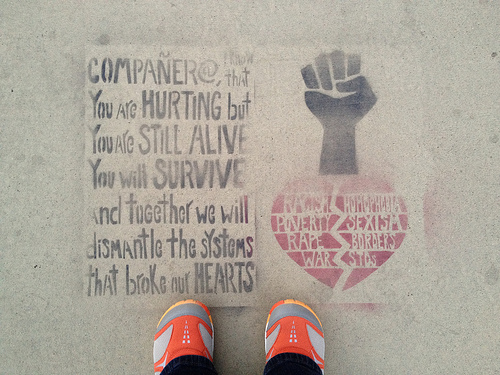
together we will dismantle the systems that broke our hearts

Not long ago, I joined up with a motley crew of writers desiring to live in a way that proclaims that Jesus is Lord and Caesar is not. Folks are writing this week on the topic of solidarity, and like a good student of liberation theology, I have a number of thoughts on the matter which I can distill to Proximity, Listening, and Humility. I want to position myself near those who are oppressed and hurting like Jesus did, I want to honor their stories, and I want to take cues from them. I learn a great deal from Christena Cleveland (please stop whatever you are doing and read this series now), Shay Kearns, T.F. Carlton, Sarah MoonMihee Kim Kort, and D.L. Mayfield.

And if you missed them the first time around, I've touched on similar themes before:

waging peace: conflict, christian unity, & power
sacrificing privilege on the altar of grace
all oppression shall cease: a feminist theology of power
a church disarmed 
tragically hip: privilege & the emerging church
to love is to serve is to liberate

What does solidarity look like in your life? How do you need it? How do you demonstrate it? How does the Church practice this well and poorly? How can we do it better? How does Jesus model solidarity with those who are outcast and oppressed?

waging peace: conflict, christian unity, & power


Those who hate conflict will avoid it like the plague, but I'm not one of those people. It's not that I like to fight, balls-out, guns-blazing, I-will-CUT-you. I just happen to believe that conflict is inevitable, necessary, healthy, and not inherently indicative of battle lines drawn, Us vs. Them, or all-out-war. My life is full of people with whom I disagree about a million things, and we manage to love each other all the same.

I'm realizing that my (relative) comfort with conflict is a minority position in many Christian circles, where disagreement can be conflated with attack and one of The Worst sins: disunity.

Whenever Christians get to disagreeing, as we're wont to do, someone inevitably waves the "UNITY!" banner, imploring folks to pipe down and get along. This is understandable, to a certain degree. We are supposed to be known by our love and what-not.

But conflict itself is not a threat to peace, and those pleas for unity rarely occur on neutral ground. When the Supreme Court was considering marriage equality, I read arguments by Christians on the right and the left about how disagreements were a distraction from what God really cares about.

It may be natural to prioritize our own passions, but one person's "issue" or hypothetical thought exercise is another's actual life. If I, as a straight, cisgender person, can ignore the fact that LGBTQ Americans do not share many of the rights that I take for granted, my "opting out" is a luxury and privilege, proof more of my callousness than enlightenment. It's also a wildly presumptuous leap to project my own apathy onto God. 

Unity pleas rarely occur in a vacuum, and they can come off as silencing dissent when issued by Christians for whom the "fight" is not personal. Those without a horse dismiss the race with record speed, but not having stake in the battle du jour should never be confused with the moral authority to explain how there are bigger fish to fry--or the ability to impart God's own perspective!

There are uneven power differentials at play within many conflicts. Glossing over them not only misses the heart of much disagreement, it impedes the very reconciliation those unity pleas strive for. The most heated conflicts are deeply personal, and injustice and hurt may bring the most heat of all. We all have unique perspectives and intrinsic value, but if someone is being hurt, silenced, marginalized or oppressed inside a conflict, that inequality bears profoundly on its resolution.

Unity pleas sound noble, but they cannot bring about healing or justice, and without those, there can be no real unity--just the appearance of it (and even then only from select vantage points).

Conflict must be worked through and harm accounted for, even the hurt we never intended. We rarely hurt each other on purpose, but good intentions don't mean never having to say you're sorry. We are responsible for our words, actions, and inactions: meaning well alone is not absolution. 

I generally mean well, and I hurt people all the time, usually the ones I love the most. Everybody does, and we rarely intend to at all. Christians who believe that we're all sinners should know this better than anyone, but again and again, we act as though meaning-well covers over a multitude of (our own) sins.

But that's not how it works. People rarely intend to be racist or misogynistic, and yet well-intentioned people say and do hurtful and oppressive things all the time. This doesn't make us bad people but human people, and part of being human is being accountable for our behavior. We all mess up, and hurt isn't any more palatable just because the offending party didn't intend it. 

If a wounded party has already experienced marginalization because of race, gender, sexuality, abuse, etc., conflict is often experienced within a deeper, systemic context and repeated pattern of social inequality, which cannot be ignored if we care about unity, peace, and love. If someone lets me know that my words or actions caused pain, I need to account for that, especially as a person of privilege. I need to listen, and I need to make it right.

So yes, by all means, let's assign positive intent. Let's not assume that people intended us harm (or that our own critics are picking fights for sport or being too "sensitive"). But then let's also choose to acknowledge the power dynamics at play and take responsibility for our own behavior before pleading, "Can't we we all just get along?"

There are no shortcuts around conflict into unity. Unity involves forgiveness and loving well, but it is also about righting wrongs. Conflict is not a threat, especially to a unity that did not exist in the first place. If there are inequalities within a community, pleas for unity can function as unwitting endorsements of existing hierarchies and an unjust status quo. Real peace is not kept but made: forged in fire and hard-won. Unity is like peacemaking, and it won't be achieved without the kind of love that sees conflict through all the way to the wholeness of shalom.

Thursday

beyond the possible


Cecil Williams and Janice Mirikitani have been at the helm of one of the most extraordinary churches in America for over fifty years. Beyond the Possible: 50 Years of Creating Radical Change in a Community Called Glide tells the story of their lives, their church, and unfathomably transformation wrought in San Francisco's Tenderloin District and beyond through the passion, love, and dedication of Glide Church and community.

It is a remarkable book, beginning in Cecil's childhood in segregated west Texas in the 1930s. He recounts harrowing and heartbreaking stories of racism and oppression in America and his own experience as the first of five black students at Perkins School of Theology at Southern Methodist University. Janice spent her own childhood in Japanese internment camps. Both were well acquainted with injustice and longed to be part of something better, of healing and new life.

Cecil moved to San Francisco in the 1960s to pastor a dying white church in the heart of one of San Francisco's most notorious neighborhoods, a place where homelessness, addiction, violence, poverty, and sex work were rampant. He opened Glide's doors to everyone, resurrecting that dying church and the community itself by turning Glide into a safe haven, a center for city revitalization, and a catalyst for social activism and spiritual change.

The book fascinates. Glide was inclusive long before that was a cultural buzzword, welcoming people of all races, incomes, sexual orientations, and gender expressions, as well as addicts, sex workers, and people experiencing homelessness and mentally illness. The stories are jaw-dropping: the community organized against police brutality, embraced the unwashed and unstable, had unfathomable run-ins with hippies, and helped thousands experience healing after abuse, incarceration, and much heartbreak.

When Cecil came to Glide, it had 35 congregants. Today, it has 10,000 members, (and 25,000 volunteers serve its programs annually). They serve three hot meals a day, seven days a week and operate integrated housing facilities for working families, the mentally ill, and formerly homeless. Glide birthed community centers, after school programs, health clinics, and recovery programs, and they've changed the face of the neighborhood for the better in myriad ways.

The chapters are named after some of the church's core values, including Creativity, Freedom, Nonviolence, Recovery, Diversity, The Beloved Community, and more. Glide's commitment to storytelling, vulnerability, truth-telling, empowerment, and radical acceptance is inspiring, but Beyond The Possible doesn't pull punches, either. They share some of the hard and ugly realities encountered in fighting addiction, racism, and systemic poverty and glimpse the long road of healing after abuse and the ongoing difficulties inherent in a truly diverse community. They also share how publicity and celebrity friends brought a Glide a spotlight and funds as well as personal and other problems.

Cecil Williams ministers from and operates out of an understanding of liberation theology, and as I read, I realized how much the white church fails to comprehend Black theology in particular. Some might not find the book to be entirely orthodox (I'm not sure if Janice would describe herself as a Christian), but it offers an important perspective and a needed counter to some of what passes for orthodoxy in many evangelical churches. Williams and Mirikitani have much to teach the rest of us about love-in-action and the part we can play in bringing tangible, good news to our sisters and brothers here and now.

There's a lot to like in the book, especially for those interested in sixties counterculture and history, social ministry, community development, church diversity, vulnerability, shared power, church growth, social justice, storytelling, or faith activism. Honestly, if you're looking for a lot of Jesus, this may not be your cup of tea exactly, but a more conservative church or Christian could still gain a great deal of wisdom from the perspective and example offered within these pages.

For folks burned by trauma, closed doors, small questions, and church-as-usual, Beyond the Possible might just been the good news you're longing to hear.


Book provided by TLC. Opinions mine.

tragically hip: privilege, sexism, & the emerging church


I.

Conversation heated this week surrounding a recent Emergence Christianity gathering and the seemingly anti-feminist sentiments offered by Phyllis Tickle in her closing keynote. Julie Clawson (and other women) unpacked some of the tensions those words presented in a faith movement that prides itself on being forward-thinking, inclusive, and postmodern only to be chided by male leaders for launching "attacks".

Here we go again.

Can we talk about privilege? I've noticed that people's interest in discussing or accounting for privilege may be inversely proportional to the amount they possess. Which can be sort of a problem.

No one likes to admit to possessing any advantage over anyone else. You know, Bootstraps! and all that. Remember the Romney campaign and the Republican National Convention this past summer? We built it!

(I don't think this is a peculiarly American tendency.)

Upon hearing the word "privilege," many conjure images of prep schools, country clubs, and Old Money and launch into defensive mode: You have no IDEA what my life is like! / how hard I work! / what my family of origin was like!

You'd be right. I probably don't. You don't know my whole story, either, but these conversations can be windows into one another's experiences and a chance for us to learn.

Having privilege doesn't mean that one's life is easy or that you've never experienced disadvantage or pain. It is not a personal indictment but an acknowledgement that social and institutional benefits enjoyed by some are denied to others.

These conversations are complicated by the fact that many people will experience privilege in one realm and oppression and disadvantage in another. (Shay unpacks this well here.) I experience privileges as an able-bodied and neurotypical person, including easy access to buildings and restrooms, being able to hear fire alarms and announcements, and trusting that people aren't much concerned about my potential for "violent" break-downs.

Education and socio-economic status grant me other advantages, as does my Christian faith (despite what the distressed might have us believe). White skin confers an invisible knapsack full of privileges about which I rarely am made to give a passing thought. (Dianna Anderson explores this more.) Being heterosexual and cisgender allow me social and legal benefits that many cannot claim--or take for granted.

Beauty and intelligence confer advantages, along with speaking English (extra points for doing it without a perceivable accent), affluence, class, and age (or youth, depending), and there are certainly other areas I'm leaving out.

Privilege is largely invisible unless you don't possess it. Although it's easy for me, especially as a straight, white person, to remain oblivious to many of the advantages that I enjoy, in the areas where I lack access or power, that void is glaringly apparent and not so easily forgotten.

Which brings me to male privilege. Lord, have mercy.

II.


In the early '00s I was a church youth minister, and during that time, my supervisor begin planting a missional, emerging church that Jim and I were part of as well. I read the books, relishing the wrestling that stretched my faith and energized the ministry.

But in 2005 we relocated to a small town, trading city life and our emerging church for camp ministry and a decidedly unsexy church full of modernist sort of folks who are double and triple our age. There was nary a goatee or guitar in sight, but we found a home there anyway, embracing liturgical tradition and the grace and generosity of community unlike ourselves in age, income, and often worldview.

It's only in recent months and years, though blogging and twitter, that I've waded back into the "emergent conversation." (Or whatever it's called now. I'm rusty.) My theology still overlaps, but I don't feel the same vigor. I feel like an outsider and not only because of the time that's passed.

As a woman, I am outsider looking in on a movement that appears to have lost much of its initial Kingdom-oriented vitality and practical, boundary-busting appeal.

Emergence Christianity online is largely a boys' club dominated by academics, celebrity voices, and professional clergy, and the climate can be dismissive of or even hostile toward the voices of women and people of color. They talk about being welcoming, affirming, open, and inclusive, but not everyone experiences that in actuality.

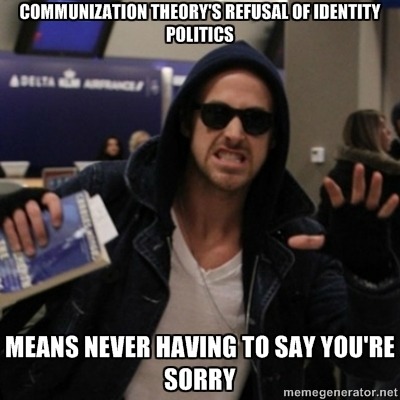
It's disheartening to hear white guys dismiss concerns about diversity and justice work as "identity politics," favoring theory and theology over people, stories, and meaningful change. What does it matter if you've got a rigourous Marxist argument and a brilliant vision for achieving actual systemic equality if you are actually talking over and silencing the very people excluded by current systems favoring you? There is nothing progressive about mansplaining.

the best Tumblr ever
Accusing people of "playing identity politics" is a fun trick played by voices on the Right, too, on gay people who speak up about bullying or discrimination, women who expose rape culture, and people of color who highlight racism in America. One privileged man's "politics" is another's identity, culture, and daily experience of injustice in the world. This dismissive categorization comes across like an intellectualized version of pipe down / play nice.

Is it possible to unite across demographics and to experience identity in being the body of Christ and liberation through growing the upside-down Kingdom of God together? Absolutely. That is part of the hope of the gospel, and I've certainly seen healing, beauty, and reconciliation come through Christ's love and common work. But privileged folks, whose identity and experiences are also socially located, must stop expecting others to check their personhood at the door and assuming the sort of faux neutrality or moral high ground we may not, in fact, possess.

We can't build the Kingdom of God with the tools of Empire and privilege.

III.

Lack of female participation on a popular emerging theology blog led to an invitation not long ago for women to speak up, and they did in spades. I was particularly interested in how emerging pastor Nadia Bolz-Weber responded:

In general women are socialized to be fair-minded and aware of not stating our opinions too boldly (lest we offend or alienate) and to make sure everyone stays friends. This isn’t a completely bad thing, but as a result most of us have never learned to hold a position or stand firm in an argument because we are too busy trying to make sure people like us. So of course less women comment on the blog of a guy who’s not terribly concerned with any of that.

I don't disagree with her assessment of a particularly feminine tendency not to rock the boat. We are socialized that way, but it's patriarchy that enforces it, frequently painting (and punishing) assertive women as divisive, shrill, vitriolic, crazy, combative, contentious, and worse. Tony, who has made a brand out of being an ass (his words), is rewarded as a man for engaging aggressively, but when women accepted his invitation to comment and reacted strongly to his abrasive brand, he wrote a follow-up parable "releasing" angry critics from hanging around.

To me, this begs questions about what are the more "feminine" ways of relating, and why do progressive Christians preference [in men] more argumentative and "masculine" styles? Is this a value to uphold or subvert? Is there room practically in a movement framed as a conversation for a variety of personalities, backgrounds, gifts, and leadership styles and for people who don't conform to the prescriptive gender assumptions many still cling to, even unconsciously? Can we differentiate critique from attack, and is there room to disagree?

We aren't anywhere close to being post-racial, post-feminist, or post-equality, and I wonder into what are we "emerging" if the old ways of patriarchy and protected, hierarchical leadership still hang on so doggedly?

IV.

Despite all of this, I'm choosing to be encouraged. My hope is not in Emergence, politics, denominations, or celebrity pastors, but I do hold out hope for the one holy catholic and apostolic Church wherever She loves well. I hope in my sisters and brothers, in the Spirit moving, and the Kingdom of God taking root in even the darkest, most barren reaches of Empire. I'm choosing to sing freedom songs with Sarah Bessey who is done fighting for a seat at the table:

I have a tremendous well of hope for the voice of women in the church. The men at the table may be loud but the pockets of hope and love and freedom are spreading like yeast. I see it. I feel it in the ground under my feet. More and more of us are sick of wa
iting for a seat and so we are simply going outside, to freedom, together. And here, outside, we’re finding each other and it’s beautiful and crazy and churchy and holy. 
We are simply getting on with it, with the work and the community and the dreaming and the loving and the living out of the hope of glory.
We are getting on with it indeed, and no label, conference, leader, or small-c-church will legitimize or erase the work that God in doing in our midst.

So let's raise a glass to the lovers and truth-tellers. To servant leaders, liberation seekersencouragers, dreamers, readers, fighters, thinkers, pilgrimsstorytellers, and friends. To womanists, activistssages, survivors, and scholars. To artists, listeners, prophets, pastors, mamas, writerswrestlersmystics, feministscontemplatives, and women of valor. To question-askers, shit-stirrers, breach-menders, Kingdom-builders, boundary pushers, and trail blazers. To the bold, brave, honest, real, kind, and wise. To bakers, peacemakers, and rule breakers; to all the unsung faithful; and the daily practice of sacrificial, resurrecting love.

To lighting bonfires and raising something beautiful out of ash.

Related Posts Plugin for WordPress, Blogger...