Showing posts with label garland of grace. Show all posts

Monday

God gives to his beloved sleep


If you're gonna go back to work full-time after seven years, it's probably best to go back after your youngest kid starts kindergarten rather than just before, especially if you're planning an October move from your home of more than a decade. We managed a few garage sales and cleared out a good bit of not nearly enough stuff ahead of time, but that and finding a new place and summer camp and commuting and starting a business sorta ate into what should have been packing time, which is why two weeks later we're still not entirely out of the farmhouse. (Hold me.)

Summer disappeared in a blink I barely remember. Team Paul could use a vacation, but I'm not sure where our suitcases are, and we're committed here till Christmas. Adulting is not for the faint of heart.

But the expectant canvas of vacant walls and as-yet-unmade memories are gifts, if lonesome ones, and our weary hearts receive them afresh, like amber leaves and dawn's new mercies.

Wednesday

when life just doesn't add up {guest post lauren}

Lauren is someone I know via Twitter, and I'm glad to host her words here today. She gives voice to some of the difficulties of reconciling the faith we inherited as kids with the frayed-edge realities of adult life, and I think it will be a familiar story to many. It was for me. Thanks, Lauren.


I’ve been angry with God. I don’t know the day it started. I didn’t even realize it until recently. What I know is that some dark, unrelenting force has been lurking under every experience, every joyful moment, every thought for more than a year. The crux of it is this: this is not the life I feel I was promised. I sacrificed and waited, prayed and fasted, casted my cares, and praised my way through. And I’m still not where I imagined I would be. I still haven’t come to terms with the fact that life isn’t fair.

Growing up, we were in church almost every day. Sunday morning. Sunday evening. Prayer on Monday and Tuesday nights. Bible Study on Wednesdays. Youth activities on Saturdays. Underneath all the scripture, books, classes, sermons, lectures, hugs, corrections and honest-to-goodness love, I got this message: Do the right thing, and you will get the right life. Along the way, I made some bad decisions. I wasn’t perfect; I felt like I was punished accordingly. I also saw the ‘saints’ talk about (and sometimes experience) difficult times, like death, divorce, and unemployment. But I still knew, I mean truly believed to my core, that ultimately, if I would just obey God’s word, I would have a good life with mostly joy, mostly stability, mostly peace. Depression would be a thing of the past. Resentment would be something that only sinners felt. Being broke? Oh no. That was clearly a judgement for people who were of reprobate mind…and neglected to pay their tithes. Definitely not for me.

When it comes right down to it, I guess justice and logic have been my guiding lights. 1+1=2. Ice cream and cheese cause gas. Sinners go to hell. You know, things that make sense. But my God, was that wrong. I mean, for one thing, I can eat Kraft Mac & Cheese with no problem, but no Sonic milkshakes?!

Cognitive dissonance is the state of having inconsistent thoughts, beliefs, or attitudes. Seeing Trayvon Martin’s murderer walk free is one violent example of cognitive dissonance for me. On the one hand, I was taught America was a country of justice, freedom, and brave men. On the other hand, I saw a coward shoot an unarmed teenager through the heart and receive no punishment. How could this be? In my mind, I still struggle with it. One of these has to be wrong. America is bad and killers walk among us? It's a struggle to come to terms with these types of injustices. Nuances aside, wrong is still dead ass wrong.

So with my faith, I really still have not been able to settle in my heart that "Doing the right thing" may not lead to "A good life." Perhaps it’s my foolish Millennial optimism. Perhaps my reasoning skills are amiss. I certainly have sin I haven’t acknowledged or repented for. Whatever it is, the discontent led to an abiding anger with God, and this, of course, led to more poor decisions. But it also led me to re-align my understanding of the world. God probably hasn’t sent disease to punish the wicked. The rapture, as I learned it, may be myth. Unfortunately, dairy still causes awful tummy-aches. I’m still driven by logic, but I question more--and I allow room for more than one right answer.

Still, I kind of keep expecting God to swoop down out of the clouds, say “Just kidding!” and give me my husband, 2.5 children, big bank account, and endless joy. I think, “Fellowship of suffering, got it, now give me my REAL life!” I don’t know if any of this will ever truly make sense to me. Some part of me will probably always feel like I “deserve” more (ignoring my wildly inflated sense of self-righteousness).

But I’m slowly (and I mean snail’s pace) learning to build a life of what is, not what could have been or what was supposed to be. I’m thanking God through hot, reluctant tears and an angry heart because I know, This is my good life. It will never ever be easy, I will probably always battle depression and loneliness, and nobody is going to rescue me, even if I’m really, really faithful. God still loves me, and I believe no tear falls in vain. I’ll shake my metaphorical fist toward heaven, twist and rail against God’s tight grip and collapse from emotional exhaustion, but He won’t let me go.


Lauren lives & works in SC. She loves Jesus, food, nieces, and science fiction. She's working daily to decolonize her own mind as well as the minds of those around her. You can follow her on Twitter @whimsikal.


Thursday

a beautiful disaster {giveaway}

Marlena Graves is a wise woman who loves Jesus and knows the Scriptures intimately. Our paths crossed at the Festival of Faith & Writing this spring where she appeared on an engaging panel about race and Christian publishing. Graves writes with the winsomely rare combination of authority and humility, and her new book, A Beautiful Disaster, is a study of truths hard-learned in the wilderness. 
There are no pat answers here--just the wisdom of one who's walked the valley of the shadows and kept the faith. She doesn't romanticize or trivialize the desert but illumines how God can utilize even heartbreak for growth and good, drawing from the wisdom of the Desert Father and Mothers as well as modern mystics like Kathleen Norris, Dallas Willard, and Thomas Merton. I'm so happy to have Marlena here today with an excerpt from her book, a worthy title for personal or group study.

Stability in Community (Especially When Community Irritates Us)
We cannot love well unless we are continually being transformed into loving human beings. How are we changed into more loving people? Through reliance on the Holy Spirit while observing those who love well, allowing ourselves to be loved well by others, and being open to receiving the love of God. Bernard of Clairveaux notes, “The more surely you know yourself loved, the easier you will find it to love in return.”i
We cannot love well and be loved ourselves if we are not committed to a community of Christians. Loving and being loved require that we become stable and active members of the local body of Christ. Drawing on the wisdom of Abba Moses, Bradley Nassif advises that we “stay put and be content with our lives. . . . We must not move from place to place or dwell on what we do not have. . . . We are to learn how to deal with ourselves and our environment where we are as we are.”ii
It is very important to find a good community. A good community doesn’t mean it will be a perfect community. And sometimes God places us in communities we would not have chosen had the choice been ours alone. Initially, none of the life-giving communities I’ve belonged to met all my expectations (as if they exist to serve my preferences). I had to give up some of my expectations in order to accept the work of God in my life and the work God wanted to do in the community, some of it through me. Once we’ve found a community that accepts the way God has made us and is within the bounds of orthodoxy, we stay. We grow roots. We take a vow of stability.
Stability becomes a spiritual discipline when the theater seating, contemporary music, and strobe lights get on our nerves. Or when the uncomfortable pews, organ music, and liturgy irritate us. Maybe the messages leave much to be desired—or the building blandly frames a Sunday experience devoid of beauty. Nevertheless, we stay, grateful for the many gifts of grace God offers through the community. We don’t flit place to place, rootless, like souls without a home.
I am not advocating that we remain in a toxic and abusive community. That we do not do. In that situation, we do what needs to be done for our health and the health of our loved ones. Employment and other familial circumstances may also remove us from a community. But I worry that too often we let superficial reasons, like laziness and being too busy, keep us from living a life of discipleship in our communities. Dennis Okholm writes, “Stability means being faithful where we are—really paying attention to those with whom we live and to what is happening in our common life.”iii
Changing into a more loving and generous human being is a slower process than we’d prefer. It takes longer than we want it to because our unloving ways are so deeply ingrained. But change in general involves, as James Bryan Smith says, “adopting new narratives, spiritual disciplines, community, and the help of God.”iv These modes of change do not have instantaneous powers of transformation in and of themselves. But together, over time, they transform us.
We might wonder what a transformed, loving person within community looks like. Jan Johnson provides a concrete though not exhaustive list of loving capacities that will develop in us as we abide in Christ—which as we have noted entails abiding in Christian community. She tells us that abiding in Christ will turn us into people who:
• live with joy and gratefulness
• bless enemies (difficult people)
• don’t hold grudges
• care deeply about others
• don’t run off at the mouth but offer caring words
• go the extra mile
• live with purposeful intentionality
• are humble (letting go of pride and not grabbing credit or engaging in power struggles)
• never, ever judge (that’s God’s job) (Matt. 5–7)v

Learning to Love Well
We grow the most and learn to love the best when we are around those who are different from us. If our ability to love is never challenged, how will we know if we really and truly love? There’s nothing wrong with befriending and hanging out with those who are like us. But if we are to live with joy and gratefulness, not hold grudges, and learn to go the extra mile, we must be open to living among and befriending those in our communities who aren’t like us.
We might ask ourselves if we have good friends who are of different races and ethnicities, friends with different political views, friends from different socioeconomic statuses, and non-Christian friends. If not, why not? We are limiting our experience of the life of God and our resemblance to Jesus if we do not frequently and closely relate with those who differ from us. We need to tear down walls, not erect walls. In our cultivation of friendships, we must be careful not to exclude others. Our relationships aren’t for us alone.
The wilderness opens our eyes to the intrinsic value of Christ’s body by stripping us of our independence. It shows us how dependent we are on the gifts and graces of God. Most often God infuses these graces into our lives through the lives of other believers. Among others we can better figure out what is good for us. With them we can discern what is necessary for our well-being. It’s together that we live a robust life in the kingdom of God and bring life to others. It’s together that we survive in the wilderness.

Marlena Graves, A Beautiful Disaster, Brazos Press, a division of Baker Publishing Group, ©2014. Used by permission. http://www.bakerpublishinggroup.com

Want a copy of Marlena Graves' A Beautiful Disaster? Leave a comment related in some way to community, the wilderness, or books, and I'll draw a winner Sunday night.

i Bernard of Clairveaux, “On Loving God,” in Bernard of Clairveaux: Selected Works, The Classics of Western Spirituality Series (New York: Paulist Press, 1987), 179.
ii Bradley Nassif, “The Poverty of Love,” Christianity Today, http://www.christianvisionproject.com /2008/05 (accessed September 24, 2008).
iii Dennis Okholm, Monk Habits for Everyday People: Benedictine Spirituality for Protestants (Grand Rapids: Brazos, 2007), 91.
iv James Bryan Smith, The Good and Beautiful Life: Putting on the Character of Christ (Downers Grove, IL: InterVarsity, 2009), 189.
v Jan Johnson, Invitation to the Jesus Life: Experiments in Christlikeness (Colorado Springs: NavPress, 2008), 19.

Wednesday

out of ash


The trunk is full of clothes for the Salvation Army, and the recycling overflows. Mail piles, junk drawers, closets, toy bins: it’s all fair game. I’m the culling, sorting, take-no-prisoners arranger of disorder.

Well, today I am. Even Type Bs have their breaking point, somewhere between la vie boheme and utter chaos, and I found mine sometime after the furnace broke and the vomiting started.

Three day weekends aren’t the same once you have kids. I mean, it’s a long weekend all right, but not like it used to be when we’d stay out late, just us, and linger in bed all day next. These days, Jim works weekends, and I’m home with the monkeys, who are too sick for adventuring but not too sick to bicker and pick each other raw.

Try as I may, I can’t make them calm their hearts, but if my counters are clear, perhaps I’ll calm mine. Our house, which lately looks like it’s been hit by a tornado, is a metaphor for every furious squall I can’t control, so I’m starting with what I can. One shelf. One dresser. One pantry.

We lit a bonfire with the Christmas tree and toasted marshmallows in the flickering blaze. I’m tackling my temper next. Every blood-soaked strand is fuel for the fire.

Forget the former things;
do not dwell on the past.
See, I am doing a new thing!
Now it springs up; do you not perceive it?
I am making a way in the wilderness
and streams in the wasteland. (Isaiah 43:18-19)

A way through the wilderness. Streams amidst the wasteland. I’m trusting spring lies waiting beneath winter’s dormancy and toasting to cleared clutter, setting fires, and the new life which arises out of ash.

Thursday

on parenting honey badgers


I’m a natural with babies. One of those earth mama types with babes slung close to my heart, I rarely met an early parenting problem that couldn’t be fixed or at least ameliorated by proximity to my breasts. Put a boob on it! It was like having a superpower.

But even as a kid, I was good with babies. I had a booming babysitting business watching the neighbors’ infants and toddlers for three bucks an hour. The 90s were different, man. Back then, no one thought twice about leaving tiny children in the charge of an eleven year old Girl Scout with a child care badge.

Connecting with teens comes pretty easily to me, too. I’ve got over a decade of youth ministry under my belt and know more ice breakers and group facilitation tricks than a lifetime of team-building retreats could exhaust. Nerdy, popular, troubled, loud–I enjoy all sorts of teenagers, even the stinkiest, silliest middle schoolers.

Babies are my jam. Awkward adolescents are my cup of tea. But little kids are tough. Little kids are honey badgers. I have two whom I love fiercely, and parenting them is the hardest thing I’ve done in my life.


Remember My So-Called Life? “I cannot bring myself to eat a well-balanced meal in front of my mother. It just means too much to her.”

Grungy, melancholic Angela Chase captured my fifteen year old heart, and she’s still among my most beloved fictional characters. But these days, I feel a peculiar affinity for her mom Patty, because Kyrie eleison, being on the other end of that fork might just be the death of me. My fiercely independent children never met a hill they weren’t willing to die on, and our dinner table is their perennially favorite last stand. At just four and six, their sighing, eye-rolling, and angst-y tears could give Emmy-winning Claire Danes a run for her money.

If they aren’t battling each other, it seems like they’re double-teaming me. Some days feel acutely like a losing battle I never signed on for. Aren’t we supposed to be on the same side?

**

They came by their stubbornness honestly. Truth be told, their mama can be something of a honey badger herself. Parenting is nothing if not a mirror into our own flaws and inadequacies.

But slowly, we’re learning–the whole Team Paul. To control our emotions and manage our tempers. To listen with our ears and move our feet. Speaking kind words or holding our tongues, we’re helping with our hands (or keeping them to ourselves). We’re turning and walking another way into repentance, forgiveness, new mercies, and resurrection.

Learning to love with our whole selves, we honor God with all that we are. Honey badger ferocity included.

Saturday

when the darkness seems impenetrable


When we are discouraged by the apparently slow progress of all our honest efforts, by the failure of this or that person, and by the ever new reappearance of enemy powers and their apparent victories, then we should know: the time shall be fulfilled. Because of the noise and activity of the struggle and the work, we often do not hear the hidden gentle sound and movement of the life that is coming into being. But here and there, at hours that are blessed, God lets us feel how he is everywhere at work and how his cause is growing and moving forward. The time is being fulfilled and the light shall shine, perhaps just when it seems that the darkness is impenetrable.

This excerpt is from Eberhard Arnold's "When the Time Was Fulfilled," a meditation from the wondrous Watch For The Light: Readings For Advent And Christmas.  The publisher, Plough, has dozens of titles available--including many pdf and e-reader files for free--and the whole essay can be found here.

Happy new year, friends. May 2014 be full of love and hope, life and light. Time shall indeed be fulfilled.

Tuesday

why the church needs #JesusFeminist


Sarah Bessey is one of my favorite bloggers from way back, and today is the big day her first book drops.

Jesus Feminist: An Invitation to Revisit the Bible's View of Women. We need this book, friends, for a million reasons, but today I'll cite just one:

Interesting that we have a follower of the religion of man hate and perpetual victim hood ‘educating’ us about Christianity. You do realize that GOD is male ? Obviously you haven’t the slightest idea of biblical manhood, or womanhood. The alternative being that you were sent by the coven to help further defile weak willed women. Which is it ? I doubt my comment will be published as feminists fear the light of truth and can’t bear to hear it. As you read it and before you make assumptions, no Suzannah I am not a beastly, oppressive, rapey male hell bent on upholding the ‘evil’ patriarchy, that has so benefited women.. I am a truly strong Woman who is comfortable in her own skin, that of a genuine Woman. I celebrate my womanhood and Almighty GOD that in HIS wisdom formed me as such, not damn it, or HIM. I celebrate my husband’s manhood, not attempt to ‘cure’ him of it. What pathetic, sad little creatures you are. Seek HIM while HE still may be found. (Yup, this happened.)

A few months ago, I wrote a poem at A Deeper Story (where Sarah is an editor). It was about my family of origin and was fairly innocuous. I mean, it was poem, a personal piece about faith and growing together in love, not anything remotely incendiary like an essay on objectificationpurity culture, or a feminist theology of power.

But apparently a little poem about freedom and healing can inspire an anonymous commenter to infer I was "sent by the coven." THE COVEN, Y'ALL. You write one poem about humility and shared ministry on a Christian website, and folks conclude you must be "a follower of the religion of man hate and perpetual victim hood" instead of a sister Jesus-lover committed to resurrection, redemption, and the Kingdom of God on-earth-as-it-is-in-heaven.

This is why need Sarah's book, Jesus Feminist. We need her freedom songs about a King and a Kingdom making all things new. She is telling a bigger and better story, and I pray the Church is listening, because there is work to do, and we need all hands on deck. We're in this together.

Happy book-release day, sweet Sarah. Ever grateful for your work and witness.

Saturday

miss you

It's been a while, friends. Between summer camp, a broken computer, back-to-school, and a whole lot of missing/bootleg phone shenanigans, I kinda fell of the grid and stayed there.

Slowly we're climbing out of the camp fog, eating meals at home without unending choruses of "YOU CAN'T RIIIDE IN MY LITTLE RED WAAGON!" or full costumed dining hall dinner theater riffing on Duck Dynasty and Taylor Swift. We're finding our way back. (Jim had nearly a whole weekend off this month. Lookout!)

Shall we recap?

There were lambs on leashes here for a while, who frolicked about not unlike the Bea, my favorite internet farm animal. They proved to be a bit much to wrangle into the barn at night by myself, and since we didn't have sufficient fencing or shade, they went to live on a goat farm. (A real one. No lambs were eaten on our watch.)


We went down the shore with dear friends in August, where we pedaled like champs, played like kids, and ate like kings for one glorious week.


Dylan started kindergarten and finally got to ride that bus she's been talking about pretty much since she could talk. It's a long day, but our little reader is a happy student.


James started pre-school and is loving every social, playful minute.


And then, just like the fireflies, summer was gone. Our lawn is already blanketed in crunchy leaves. We gathered around a fire last weekend, and today I broke out tights and chai. 

Truth be told, I am not particularly enamored with fall, which puts me in the minority, it seems. Folks love them some autumnal everything with a ferocity I can't quite comprehend. I like pumpkin, boots, and festivals as much as the next guy, but autumn always feels a bit like the slow march to winter's barren wasteland.

Womp Wommmmp.

September's just hard, even with its promise of fresh starts. I never quite recover from camp's frenetic pace or the oft-solo parenting by the time the school schedules rev back to life and the trees shed their green. Everything still feels a bit raw, but slowly, it's starting to heal.

This fall, I choose to breathe the rhythms of rest. I want to work and love and create from a place of fullness. 

I want to be well.


Tell me something good. What are you working on, thankful for, looking forward to, reading, watching, or enjoying? I'm all ears.

Thursday

what it is is beautiful {giveaway}


I'm thrilled today to introduce you to Sarah Dunning Park, although since she is poet-in-residence for a little media empire known as Simple Mom, you may already be thoroughly charmed by her lyrical take on aspects of motherhood both sacramental and mundane. Her first volume of poetry, What It Is Is Beautiful: Honest Poems for Mothers of Small Childrenhad its official release this month, but I was lucky enough to receive my own copy when Sarah and I met up at our alma mater last May.

Sarah and I traveled in similar circles in college, but she graduated early, and I never got to know her as well as I wanted. Reconnecting last year on Twitter and then again in person for an afternoon with her and her girls was a delicious treat and exactly what my heart needed.

Sarah's a good mama, not because she's perfect or put together but because she's honest and kind. She generously agreed to share a poem here as well as a copy of her new book with one reader. (Yay!) It's available for only $4.38 right now at Amazon, so you might as well pick up a few for gifts. Mother's Day is just around the corner, and these poems are a cup of cool water and a needed "me too" to harried mamas in search of a little peace amid the storm of parenting littles.


Keeping the Peace

I saw it out of the corner of my eye,
noticed its tall, silver form
long before naming it in my mind:
heron. It perched, utterly graceful and
still, on a fallen trunk that sloped down
into the creek we cross over every day.
Fog was rising from the water,
and I wished I could stop the car,
approach quietly with camera in hand,
and somehow arrest the moment—
then lift it, intact, to take with me
as an emblem for the day.
Instead I turned away
to face the road again,
letting the moment flick past
like the flipping of channels,
and swallowing my awareness
that we live in a world with—herons.
The children were slumped behind me,
only just lulled into a dubious harmony
that would no doubt be shattered
if we stopped, or if I called out
for them to notice this marvel,
already now behind us.
I envisioned
three heads swiveling,
eager to broaden their horizons
with the wonders of the natural world.
Then I pictured a careless elbow
clipping a seatmate on the chin,
and two sets of hands clawing
at the sibling with the prime view—
of this animal
who has had the good sense to freeze
as we go barreling past.
No, I decided
(and it felt ungenerous):
today I would choose to keep
this emblem of peace to myself,
not sharing it with them directly,
but thereby preserving
the absence of conflict in the backseat,
and the heron’s solitary breakfast,
and perhaps most important,
that rare jewel—peace of mind—
for me.
© 2012 Sarah Dunning Park

To enter to win a copy of What It Is Is Beautiful, leave a comment in the vein of mothering or poetry, and we'll pick a winner Sunday night at 11:59 PM.


unsponsored content. affiliate links. please don't repost sarah's work without permission. you know the drill.

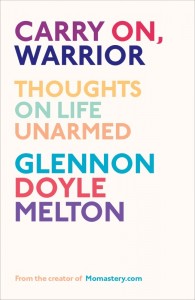
carry on, warrior


If you visit the internets now and again, it is likely that you have come across the words of Glennon Doyle Melton of Momastery.  Even if you've never read her, your sister, neighbor, or mom probably has: her post Don't Carpe Diem has 305,000 facebook shares, and that was before the Huffington Post syndicated it.

Girlfriend knows how to write words that connect, and Carry On, Warrior: Thoughts on Life Unarmed does just that. It's a roaringly funny, painfully honest, and uncommonly kind collection of personal narrative essays on life, recovery, family, truth-telling, faith, and loving well. Not everyone will appreciate Glennon's flawed-and-flighty-with-a-heart-of gold persona, but I did (and I'm not a regular reader of hers). She comes across as wildly over the top at times, but there is still something resonant and real within the silliness and self-deprecation.

A bit of the content has been previously published on her blog, which is kind of a bummer, except that they are still remarkably powerful essays. Every time, I'd be like, Man, I've totally read this one before! and then before I knew it, I was weeping or almost peeing my pants with laughter again, which speaks to the power of her storytelling.

Glennon might come across as too Jesus-y for folks who aren't religious and a little too much for some Christians (and others), but I found her grace and humor to be disarming and refreshing. I read a few passages aloud to Jim, and he loved it, too, so I'm pretty sure it's not a Women's Book (and also that Women's Books are not, in fact, real things).

Books that really make me laugh are rare, so I'll recommend them every time. There's more than enough outrage to go around, and sometimes you want to read something that makes you feel like the world isn't such a terrible place. Carry On, Warrior is like that.

TLC Book Tours hooked me up with a book, but these opinions are all mine. But you knew that;) Affiliate links, yo.

Saturday

saving my life {& a pass-along book club?}


It's been a while since I've counted, and since I'm feeling a bit grumpy about the interminable cold and cooped-up-ness we got going here, I figured it was time to dust of the old list.

an ongoing record of God's goodness, #375-399


turning 33
breakfast in bed, reminiscing about our time in Napa last spring
a birthday afternoon at the spa (look OUT)
homemade carrot cake, cuz my man don't play

tapping trees
maple syrup and pancakes
sugar shack field trip with this guy


lenten soup suppers and
Compline
Friday fish fries

daffodils prophesying life

fiction exploring a love of music and the sacred ordinary
Dylan reading up a storm


a real and true double date with real and true friends
new local wine bar in middle-of-nowhere-PA
kind friends to watch the babes

Call The Midwife (streaming free at pbs)
discovering Scandal, a show (sans teenagers and zombies) that Jim and I both enjoy

i sent my copy of Beyond The Impossible to Emily Maynard, and now i'm thinking how great a big cross-country book club would be. you mark up a book and mail it to the next person on this list. i participated in one like this years ago and loved it. who else would be down?

seeing a unicorn: my sparkling clean kitchen
singing along at the top of my lungs as I work
tiny feet getting their dance on


Where are you finding joy? Tell me something good. 

linking up with my girl HopefulLeigh's What I'm Into round-up

Tuesday

speaking life, disarming love


Spring lies waiting. It’s twenty-odd degrees, but daffodils arise unflappable. If they can believe in spite of the evidence, so can we.

You’re best friends. I speak it like prophesy. The words-make-flesh and dwell among us.

--

I have a guest post over at Tanya Marlow's blog for her God and Suffering series. It's about parenting when it's hard. (It's always sort of hard, isn't it--or is that just me?) Come by and read, and stay for Tanya's own words, so seasoned with grace and wisdom.

Sunday

not less than everything


This born and bred Protestant found Not Less Than Everything: Catholic Writers on Heroes of Conscience to be a timely and thoroughly engaging anthology. Some profiles were familiar (Oscar Romero, Dorothy Day, Mary Magdalene, Ignatius of Loyola) but many were not, and the essays whet my curiosity for more.

The thread that unites these historical and contemporary figures is a faith expression that put them at odds with their communities and quite often, Church authority. These diverse portraits of dissent, struggle, courage, and deep faithfulness offer much to challenge and encourage the catholic Church universal. My copy is well marked, and I'm still reflecting on the essays days later, which range from historical profiles to intimate tributes to beloved mentors. In the collection, church history bleeds into narrative, personal devotion, politics, current headlines, social action, parish life, and more than a few dark nights of the soul for the clergy, academics, artists, activists, and faithful profiled within.

"The establishment is always loyal to the very institutionalism of the institution in question. The dissenter is always most loyal  instead to what the institution itself claims to be about" (61). This is the heart of the book and its stories of faith practiced in ways that were perceived as unorthodox (and perhaps even heretical) but were born of deep desire to serve both God and Church wholeheartedly.

One of the most fascinating essays for me was about Bartolome de Las Casas, a priest who served as chaplain during the Spanish conquest of Cuba. The gruesome horrors he witnessed led him to give up his land and slaves, becoming a vocal opponent of the Conquest and critic of his Church that sanctioned it.

Bartolome's belief in human dignity, religious freedom, and evangelism without force were remarkable for his time. The way he opposed unjust political and religious authority, identifying Jesus with the suffering and persecuted resembled twentieth century liberation theology. In fact, Gustavo Gutierrez wrote a book about de Las Casas, attributing much of his own thinking to the sixteenth century friar who said, "I leave in the Indies Jesus Christ, our God, scourged and afflicted and beaten and crucified not once, but thousands of times."

The book also paints a compelling portrait of contemporary Catholics wrestling with Old World theology, current abuse scandals, and a faith at once ancient and timeless. It provides a glimpse into what drives some Catholics away while others remain as solidly committed as ever to the Church and faith, even while finding themselves at odds with ecclesiastical authority.

Not Less Than Everything is a worthy read for history buffs, theology nerds, progressive (and other) Catholics, Protestants wanting to learn more about Catholicism, those disenchanted with Church wondering "Can I stay?", justice advocates, authority-buckers, rule-breakers, and any Christian seeking to be encouraged by the communion of sometimes unlikely saints.

"When first confronted, this artist's work will look irreverent to those called to maintenance and preservation. But the artist, eyes open, hand extended, knee bent, is striving for perfect fidelity" (115).

Review copy provide by TLC Book Tours. Opinions mine. Affiliate links. As you were, soldier.

Thursday

without walls


Grieve not the Spirit, sister;
your brothers' blood cries out from the ground.
Be not afraid to claim your kin, for
Christ is not ashamed to call us his and
he our peace. For once, we are
not strangers but citizen heirs of
one household of God.

One Lord
One faith, to
One hope are we called

One baptism
One Body, many gifts.
One Giver
One work
One Table
One Church

The house of God built not of
mortared walls but bone and flesh:
hearts beating, breaking and bound
up in mine. Belonging, the Spirit dwells 
in our midst. Wither or bloom, 

we are keeper and kindred;
bearing burdens and fruit,
wear love well.

Wednesday

i am the 47%


“Are you in school?” she probed, stirring her tea as I set a slice of coconut cream pie before her. She’d sent the first piece back, running me ragged with demands I hustled to meet with a smile.

“No, I graduated a few years back.”

She asked from where, and I told her, but her eyes flashed a smirk. “You might not want to tell them you work here. They might revoke your diploma.”

She left a tip that better matched her icy slight than my service–or her pearls.

***

I served tables and steamed lattes for two years before it became apparent that there might not be A Real Job for me in this town at all. Should we move up our vague baby plans a bit? For what were we waiting anyway, me to brew another thousand pots of coffee?

My sister was visiting. She grabbed glasses from the cupboard, and Jim poured the Guinness.

“None for me.”

“Just a little?” I shook my head, not feeling their festive mood. “But it’s Saint Patrick’s Day!”

“I might be pregnant, OKAY?” I barked, louder than intended. Their jaws dropped in tandem and eyes bugged cartoon-wide. A few beats of shocked silence passed, and they burst wide smiles and congratulatory hugs.

I felt sick, but not with the pregnancy. How were we going to afford this baby? Jim’s ministry job provided housing and a most modest salary. Being broke without kids was one thing; you’re supposed to be poor in your twenties, right? It’s part of the lore of growing up and coming into your own.

But feeding my kids government cheese? That never was part of the plan.

***

The next day the stick read positive, and the housing authority called about a job I’d applied for months before. If that was proof of God’s sense of humor, it felt like the joke was on me.

I accepted a job with the homeless assistance program, encountering the kind of poverty and housing insecurity that generally flies under the radar. I documented dire straits in pay stubs and eviction notices. The work was good, and I liked the people, but my heart hurt for how hard they labored and what little it guaranteed.

My due date imminent, I couldn’t imagine coming back to work in six short weeks. Staying on part-time wasn’t an option, and we didn’t have anyone to help with childcare, so I gave my notice. We’d figure it out somehow.

***

As it turned out, government cheese is Helluva Good. We ate it for four and half years, and I really did see it as part of God’s provision for our family. Uncle Sam’s chick peas floated us through the lean seasons, which lasted from autumn until tax time.

Sitting on the other side of the desk to turn over our pay stubs was humbling, like nearly every check-out experience at the grocery store.

“MANAGEMENT TO REGISTER FOUR FOR A PROBLEM WITH A WIC CHECK. PROBLEM WITH A WIC CHECK, REGISTER FOUR.”

I learned to shop the out-of-town supermarket, to not dress Too Nice, and to divide my groceries meticulously, with a babe in the sling and a toddler in the cart.

First check & transaction: milk, juice

Second check & transaction: cereal, peanut butter, cheese, bread

Third/(Fourth) check & transaction(s): produce. Make it match $6 (or less); any overage requires a fourth transaction independent of the final one.

Final transaction: our own groceries. More fruits and veggies, turkey for sandwiches, cheese or possibly fish from deli clearance, pasta, almonds [too much?], ice cream [it's on sale], frozen pizza [I have a coupon]. I smile apologetically at the customers behind me, wondering if they’re frustrated at the length of this process, or is their disdain toward My Kind in general?

***

I missed my reauthorization last fall and discovered our larder a little fuller. Maybe we could weather this lean season without WIC’s cushion.

My education and growing up were solidly middle class, and in many ways, we’re just wayfarers on this strange (mis)adventure in living beneath the poverty line. We could, most likely, get better paying jobs. Our paychecks are modest, but our housing is secure. Our families could (and have) aided us in a pinch, another decidedly middle class privilege. Downward mobility and ministry were our own choice, and I won’t pretend to exist in the same boat as my former clients, even if our tax returns appear similar.

I’m not so bold. I didn’t write this until I could put it in the past tense. I worried what you’d think, that our finances, spending habits, and private decisions would be up for public review. (That’s how this works, right?)

How much do you think her boots cost?

She has an Instagram account, you know.

If she doesn’t like being “low-income,” she could always, I dunno, WORK.


We’re several months out from receiving WIC benefits and doing okay. More than okay: our needs are met and some wants, too, like signing up our little ones for tumbling at the Y.

Despite all that, we’re still the 47%, those people (like teachers at Christian schools, disabled veterans, and your grandma, for goodness sake) who are basically The Worst for earning wages below the threshold of respectability.

Folks like me. Pleased to make your acquaintance.

Monday

all oppression shall cease: a feminist theology of power


One time at Jesus camp, a stranger called the office to ask if I would "give my sexual testimony" at a local purity retreat. I declined their request, because WHAT, but it still cracks me up every time I remember. This is not that (you're welcome), but it is, in a way, my feminist testimony. How's that for an intro?

I didn't grow up in a feminist home and never took a women's studies class, but academia still played a key role in my understanding of feminism. I got my BA in religion and history and spent a semester studying poverty and community change in Washington D.C. Those disciplines and experiences rooted me in where we've come and awakened a desire to keep forging ahead toward equality.

Feminism is sometimes criticized (and rightly so) for failing to acknowledge the experiences of people of color, but I learned feminism through a decidedly non-white lens. Studying black feminist history, liberation theology, community organizing, and the devastating human effects of environmental racism, I realized how oppressions are linked and bound up in abuses of power.

In a lot of ways, power is the crux of my understanding of feminism and my theology, too, but I envision power in a radically different way, and I suspect that's a big part of what critics misunderstand.

Our world has a jacked-up relationship with power. If we're Christians, we might admit that our world has a sinful relationship with power, and as a Church, we are chief among sinners.

Racism, rape, poverty, abuse, environmental degradation, sweat shops, hate speech, human trafficking, child labor, and everyday inequalities, indignities, and violence based on skin colorsex, gender, class, disability, sexual orientation, and more--these aren't unfortunate inevitabilities but actual manifestations of oppressive power (that, if I'm honest, I participate in and sometimes benefit from).

I think the reason people bring up the "matriarchy" boogeyman and accuse feminists of wanting to "turn the tables" on men is because it's virtually impossible to envision gender or racial equality when most of our power structures are built on and sustained by gross inequalities.

But for me, feminism isn't about gaining power in a broken system; I want to burn the whole thing down and start anew. 

This is where my faith intersects my feminism: worldly political and religious power crucified Christ, and when he rose from the dead, Jesus made a spectacle of their oppressive power, greed, fear, and blood thirst. The liberation we seek is found not on the altar of empire but the upside-down Kingdom of Christ.

Jesus subversively upended one of Rome's most potent symbols of oppression and death, raising something whole and holy in its place. Christ's Kingdom grows up among us by another kind of power, and we're charged to bear its fruit: repentance, humility, servant leadership, and radical, resurrecting love.

My feminism grew out of the classroom but was nurtured in a faith that all humans are created in the image of God and that the only power that rights the world's wrongs is found at the foot of the cross and an empty tomb.

That's the kind of feminist I am.


{Day 1} Feminism and Me: On Tuesday, February 26, link up at J.R. Goudeau’s blog, loveiswhatyoudo.com, and write about these questions: What is your experience with feminism? What’s a story or a memory or a person that you associate with that word? Why does it have negative or positive connotations for you? How do you define the term, either academically or personally? What writers have you read whose definitions you want to bring out? Or, if you don’t have a definition, what are some big questions you have?


Sunday

five years long (and counting)

On this day in 2008, I published my first post here. I told stories, wrestled, and wrote my heart to keep from losing myself in the diapers and demands of new motherhood.

At first, I wrote essays for me and stories for a handful of family members scattered far from home. Along the way, I stumbled into poetry and feminist critique, and these words forged paths outside this small town, connecting us in ways I never envisioned and for which I'm grateful.

Will you indulge me in a look back? My first blog header was a wordle. Fancy, clearly.


This photo was the best existing one of me for a long time and was my avatar for years.


Jessi of Naptime Diaries made this header, and when I met Erika at Relevant, I discovered that she has the very same tree of life as a tattoo but with wild, winding roots. Kindred, we.


Last summer I re-titled (and shortened) my blog to the smitten word. The old domain obviously remains, and if anyone knows anything about adding/redirecting urls, I'd love to finally move it.


It's been five years, 707 posts, and quite a bit of fun. Thanks for walking this way with me.


Thursday

let love

{image by Annie Barnett, available from Be Small Studios. used with permission.}

Because Love that protects, trusts, hopes, and perseveres is more dazzling than diamonds and more enduring than candy hearts:

Let love.
Let it melt the frozen and forgotten places, where the wild dancing has gradually slowed to solid ice while no one was looking.
Let love.
Let it wash over those multitudes, the harsh words, the friendly fire. Unclench those fists.
Let love.
Let it open the front door to the friend all shut up in her own head, let it linger on the couch til words come. Let it set another plate, wash the next load of laundry.
Let love.
Let it break that hard heart into a million little pieces.
Let love.
Let it bind up. And let it build up. Let it stitch together the broken into quilts of comfort and mercy.
Let love.
Let it hang onto threads of hope, choose joy again and again and again.
Let love.

Happy Valentine's Day, lovelies. Please go read the rest of Annie Barnett's blessed benediction here. (Find more of her gorgeous watercolors at Be Small Studios.)


And I pray that you, being rooted and established in love, may have power, together with all the Lord’s holy people, to grasp how wide and long and high and deep is the love of Christ, and to know this love that surpasses knowledge—that you may be filled to the measure of all the fullness of God.
Now to him who is able to do immeasurably more than all we ask or imagine, according to his power that is at work within us, to him be glory in the church and in Christ Jesus throughout all generations, for ever and ever! Amen.


beyond the possible


Cecil Williams and Janice Mirikitani have been at the helm of one of the most extraordinary churches in America for over fifty years. Beyond the Possible: 50 Years of Creating Radical Change in a Community Called Glide tells the story of their lives, their church, and unfathomably transformation wrought in San Francisco's Tenderloin District and beyond through the passion, love, and dedication of Glide Church and community.

It is a remarkable book, beginning in Cecil's childhood in segregated west Texas in the 1930s. He recounts harrowing and heartbreaking stories of racism and oppression in America and his own experience as the first of five black students at Perkins School of Theology at Southern Methodist University. Janice spent her own childhood in Japanese internment camps. Both were well acquainted with injustice and longed to be part of something better, of healing and new life.

Cecil moved to San Francisco in the 1960s to pastor a dying white church in the heart of one of San Francisco's most notorious neighborhoods, a place where homelessness, addiction, violence, poverty, and sex work were rampant. He opened Glide's doors to everyone, resurrecting that dying church and the community itself by turning Glide into a safe haven, a center for city revitalization, and a catalyst for social activism and spiritual change.

The book fascinates. Glide was inclusive long before that was a cultural buzzword, welcoming people of all races, incomes, sexual orientations, and gender expressions, as well as addicts, sex workers, and people experiencing homelessness and mentally illness. The stories are jaw-dropping: the community organized against police brutality, embraced the unwashed and unstable, had unfathomable run-ins with hippies, and helped thousands experience healing after abuse, incarceration, and much heartbreak.

When Cecil came to Glide, it had 35 congregants. Today, it has 10,000 members, (and 25,000 volunteers serve its programs annually). They serve three hot meals a day, seven days a week and operate integrated housing facilities for working families, the mentally ill, and formerly homeless. Glide birthed community centers, after school programs, health clinics, and recovery programs, and they've changed the face of the neighborhood for the better in myriad ways.

The chapters are named after some of the church's core values, including Creativity, Freedom, Nonviolence, Recovery, Diversity, The Beloved Community, and more. Glide's commitment to storytelling, vulnerability, truth-telling, empowerment, and radical acceptance is inspiring, but Beyond The Possible doesn't pull punches, either. They share some of the hard and ugly realities encountered in fighting addiction, racism, and systemic poverty and glimpse the long road of healing after abuse and the ongoing difficulties inherent in a truly diverse community. They also share how publicity and celebrity friends brought a Glide a spotlight and funds as well as personal and other problems.

Cecil Williams ministers from and operates out of an understanding of liberation theology, and as I read, I realized how much the white church fails to comprehend Black theology in particular. Some might not find the book to be entirely orthodox (I'm not sure if Janice would describe herself as a Christian), but it offers an important perspective and a needed counter to some of what passes for orthodoxy in many evangelical churches. Williams and Mirikitani have much to teach the rest of us about love-in-action and the part we can play in bringing tangible, good news to our sisters and brothers here and now.

There's a lot to like in the book, especially for those interested in sixties counterculture and history, social ministry, community development, church diversity, vulnerability, shared power, church growth, social justice, storytelling, or faith activism. Honestly, if you're looking for a lot of Jesus, this may not be your cup of tea exactly, but a more conservative church or Christian could still gain a great deal of wisdom from the perspective and example offered within these pages.

For folks burned by trauma, closed doors, small questions, and church-as-usual, Beyond the Possible might just been the good news you're longing to hear.


Book provided by TLC. Opinions mine.
Related Posts Plugin for WordPress, Blogger...