Thursday

incarnation


Unto us a child is born of a woman,
nursed at her breast; the government is upon
him who shouldered the cross. Within world of sight
salvation springs up, enfleshed: rough hands hewn,
broke bread and washed feet. Water to wine, L'chaim,
by his body, we're healed. Trembling, she

touched his robe, yoke shattering, bleeding
shame, too. Daughter, he named, esteemed,
Go in peace. You are clean.

King in a cradle, born in a stable, Mighty God
traded heaven for here. Man of sorrows, stricken,
his blood-soaked shroud and ours are fuel for the fire.
From ash he arose, disarming darkness; with nail-
scarred hands and empty tomb, this Word revives
ancient tale. Another birth, grim curse reversed. Behold,
bending low what the Son of Man hallows:

Emmanuel makes all things new.


From the archives. A poem I wrote last advent, for you and for me. 


Wednesday

prayers of the body


Another summer we'd studied parables, but camp's new women's director was an artist and possibly something of an iconoclast, so she'd chosen "embodied prayer" as the theme for her staff's bible studies.

Most of us didn't even come from churches where raising hands was a thing, the "frozen chosen" being somewhat suspicious of emotional displays in worship (and in general). We liked our faith predictable as road maps and infused with intellectual vigor, thankyouverymuch.

And yet here we were, a handful of camp counselors sprawled out on the hillside, creating poses to represent the Lord's Prayer, conveying our spiritual journeys through something resembling liturgical dance, and praying with our bodies.

I was twenty years old. This did not resemble any bible study I'd ever been to (and I'd been to plenty), and I wondered if it might actually be possible to die of embarrassment.

---

Being nothing of an athlete, something of a school nerd, and everything of a virgin, I wasn't particularly connected to my body. The church culture in which I was raised, with its emphasis on the spirit's willingness and the weakness/(inferiority) of flesh, hadn't exactly led me believe that I was missing out on anything.

But when my friends danced on stage at their culture nights, I suspected that I was, sitting in the audience clapping, while they spun breathlessly, a whirlwind of brightly hued costumes and powerful choreography, their practiced footwork connecting them to each other, a shared history, and a physicality that was beautiful and good.

At the after parties, I learned to salsa, fumbling at first and slowly learning to keep pace. When the beat blared, in the low light, surrounded by friends, even an inelegant white girl might begin to feel confident in her own skin.

---

There was a tongue-talking church I visited once, with mime and prophesy, the whole nine yards. The congregation was as kind as a can be, and a young family even treated me to brunch afterward, but one of their nearly three hour services was enough.

But they jointly sponsored all-campus worship events (of a noticeably freer nature than the ministry meetings to which I was accustomed), and I loved their warm and unencumbered faith expression, so I went, every month. And I rarely had to go alone, like I often did to my own weekly fellowship.

There was something magnetic about the way they worshiped with their whole selves, and it drew us all in together, including my friends of flickering faith in Jesus and sold-out faith in dance.

We raised our hands and felt the Spirit move from the tips of our fingers to the swing of our hips.

---

That bible study on the hill was before its time, or at least, before my own. A few years later, I would join one of those ancient-future emerging churches and devour a book called Prayer of Heart and Body for a yoga course on meditation, but that summer embodied prayer still seemed silly, even frivolous.

What good was moving our bodies when we could pack our heads full of more knowledge?  (I was a platonist and something of a gnostic back then, though I didn't know it at the time.)

But seeds were planted.

I still remember discussing the posture of prayer, and something about that didn't seem quite as out there as the rest. I could see how kneeling was clearly a posture of deference and humility. Maybe there was something to embodying one's worship after all?

Cross-legged on that hill under the hot July sun, resting my hands on my knees, I closed my eyes and opened my palms, offering prayers and myself to a God who seemed almost close enough to touch.


Tuesday

31 Days of Embodied Faith


October is upon us, and what better way to revive this sleepy-of-late blog than to jump in with both feet for 31 Days?

(Hold me.)

Last year, we spent 31 Days Practicing Peace, and although I considered taking another crack at that same topic, I finally decided to take on Embodied Faith instead.

What is that, you ask?

I want to explore how we practice faith not just with our hearts or our minds but hands and breath and feet and bodies. Let's talk about the intersections of faith with work, play, art, exercise, rest, sexuality, food, hospitality, race, body image, discipline, suffering, beauty, pain, death, birth, pregnancy, gender, masculinity, illness, worship, celebration, grief, service, justice, parenting, singleness, dating, friendship, marriage, community, health, time...any area one might connect his or her humanity to an experience of God.

Let's look at scripture, particularly how Christ's incarnation affirms life in a human body and how we're called to honor God and one another with our whole selves. I want to examine embodied prayer and practices like fasting or pilgrimage that tangibly connect bodily experience to the transcendent.

I want to explore this together and am welcoming guest posts again on any topic related to Embodied Faith. One thousand words or fewer that fit alongside how we do at the smitten word. Poetry, narrative, essay, photography...this topic can be interpreted in a number of different ways, and I'm looking to get creative. Tell a story of how you meet God on the trail or in the kitchen. In recovery. On the dance floor or in the garden. In the bedroom, playground, or hospital.

What does faith with skin look like? Let's spend October finding out.

Day 2  prayers of the body
Day 3  incarnation
Day 4  God gives to his beloved sleep
Day 5  the practice of "no"
Day 6  shabbat shalom
Day 7  on sacramental feminism {guest post Krista Dalton}
Day 8  the naked ask {guest post Aaron Smith}
Day 9  where kindness leads
Day 10 fish out of water {guest post Misty Green}
Day 11 love shows up
Day 12 like precious oil
Day 13 let us breathe deeply
Day 14 unless the Lord builds the house
Day 15 let's lay down arms, love
Day 16 fold your hands {on teaching consent to pre-schoolers}
Day 17 on waiting {guest post Catherine Hawkins}
Day 18 embodied {guest post Seth Haines}
Day 19 an act of faith in time itself
Day 20 in the half-light of our love
Day 21 fasting, my iPhone, and prayer {guest post Morgan Guyton}
Day 22 from my head to my hands {guest post Heather Caliri}
Day 23 faith with scars {guest post Bethany Paget}
Day 24 do not go gentle into that good night
Day 25 with all his might {guest post Natalie Hart}
Day 26 walking the question
Day 27 the resurrection of the body {guest post Christina Tremill}
Day 28 a faith i can live with {guest post Sarah Moon}
Day 29 an ounce of action {guest post C. Wess Daniels}
Day 30 body of Christ, cup of salvation {guest post Micha Boyett}
Day 31 we are pierced women {guest post Osheta Moore}


Saturday

miss you

It's been a while, friends. Between summer camp, a broken computer, back-to-school, and a whole lot of missing/bootleg phone shenanigans, I kinda fell of the grid and stayed there.

Slowly we're climbing out of the camp fog, eating meals at home without unending choruses of "YOU CAN'T RIIIDE IN MY LITTLE RED WAAGON!" or full costumed dining hall dinner theater riffing on Duck Dynasty and Taylor Swift. We're finding our way back. (Jim had nearly a whole weekend off this month. Lookout!)

Shall we recap?

There were lambs on leashes here for a while, who frolicked about not unlike the Bea, my favorite internet farm animal. They proved to be a bit much to wrangle into the barn at night by myself, and since we didn't have sufficient fencing or shade, they went to live on a goat farm. (A real one. No lambs were eaten on our watch.)


We went down the shore with dear friends in August, where we pedaled like champs, played like kids, and ate like kings for one glorious week.


Dylan started kindergarten and finally got to ride that bus she's been talking about pretty much since she could talk. It's a long day, but our little reader is a happy student.


James started pre-school and is loving every social, playful minute.


And then, just like the fireflies, summer was gone. Our lawn is already blanketed in crunchy leaves. We gathered around a fire last weekend, and today I broke out tights and chai. 

Truth be told, I am not particularly enamored with fall, which puts me in the minority, it seems. Folks love them some autumnal everything with a ferocity I can't quite comprehend. I like pumpkin, boots, and festivals as much as the next guy, but autumn always feels a bit like the slow march to winter's barren wasteland.

Womp Wommmmp.

September's just hard, even with its promise of fresh starts. I never quite recover from camp's frenetic pace or the oft-solo parenting by the time the school schedules rev back to life and the trees shed their green. Everything still feels a bit raw, but slowly, it's starting to heal.

This fall, I choose to breathe the rhythms of rest. I want to work and love and create from a place of fullness. 

I want to be well.


Tell me something good. What are you working on, thankful for, looking forward to, reading, watching, or enjoying? I'm all ears.

Friday

christians, stop shooting our wounded


[This post explores the landscape of recovery and the fallout from abuse.]


We talked about sex in the summer camp dining hall. It was staff orientation, and we unpacked consent, abuse, and how virginity is a lousy measure of the purity of one’s heart before God. We deconstructed bad metaphors, exploring the significance of the incarnation and the imago Dei.

She found me later, a young woman who’d been through hell and back. Her courage blew me away.

“Thank you for seeing me,” she said, eyes shining. “Sometimes I feel so invisible.”


WE LOVE TO TALK ON THINGS WE DON’T KNOW ABOUT


Our sisters’ and brothers’ blood cries out from the ground. Others bear unfading scars from sexual, psychological, physical, emotional, and spiritual abuses, suffered even at the hands of those claiming Christ’s name.

We may not have hearts to understand, but we serve up solutions all the same. Do you want to be well? we ask. Take your mat and walk!

Our faith is strong! We believe in miracles, authority, and happily-ever-after. We are full of advice.

Ain’t it like most people? I’m no different
We love to talk on things we don’t know about

We want to be like Christ, desperately. But our Great Physician has scars of his own, and too frequently, we are the ones with blood on our hands.


IT TEACHES YOU SHAME


“Abuse teaches a lot of terrifying lessons. It teaches you that your body is not your own. That your hopes and feelings are irrelevant. It teaches you shame. It teaches you to be bullied under the guise of protection. It teaches you to blame yourself for the harmful actions of others. It teaches you that some people are allowed to hurt those less powerful than them. It teaches you to be afraid of sex, anything that might lead to sex, and even being alone with certain people…
All I really needed to hear but never once heard in my church growing up was that nobody is allowed to hurt me; that I have value and worth that is distinct from what anyone did to me and distinct from anything I do or don’t do; that I had agency and autonomy; that I had the right to say ‘no’; that my ‘no’ should be respected; that I also have the right to say ‘yes’ or actually make decisions for myself; that if somebody tries to pressure or guilt me into doing what they want me to do, whether that somebody is a jerk I’m dating or the leader of my youth group, then I should walk away and never look back.” (Laura Gaines)

“Spiritual abuse survivors are like any other abuse survivors. You have to meet them where they are comfortable. Some have serious PTSD issues and can’t deal with anything that might be related to their old church, including any talk of Jesus, God, church, or Sunday Services. You also have to realize that for a lot of these people, they will never go back to church, just like alcoholics don’t go into bars or drug addicts don’t hang around their old druggie friends any more.
We had faith. Things didn’t work. We were told that we didn’t have enough faith, and we got into a horrible downward spiral of self-hate and loathing because we just weren’t good enough. Because if we were good enough, things would have turned out differently.” (Deb Fuller)

Our churches have, at times, been toxic places for survivors of abuse. We have not been safe people, and we’ve squandered the trust of far too many.


BUT MY CHURCH ISN’T LIKE THAT


“If we want our churches and Christian spheres to be safe, we need to stop self-justifying and defending… We are so determined to prove ourselves right or righteous that we steam roll over people’s experiences and stories, indeed their lives, in order to be the right ones. Allow yourself to be seen as wrong; take the blame, the responsibility. Sit with the pain, the being, the story of another without trying to prove that ‘We aren’t / I’m not like that.’ That is the only way people will feel safe, heard, or stop feeling like ‘Things aren’t ever going to change. I don’t belong here. I’m too broken.’” (Aaron Smith)

As members of one Body commanded to love our neighbors as ourselves, we are each other’s keepers (in a non-coercive, I-got-your-back sort of way). Dysfunction and abuse cannot merely be contained locally; they must be dismantled and repented of systemically. We are one Church.

But instead of walking each other through the valleys, we assume authority and are not always worthy of it. We weaponize scripture, wielding it against each other. Sometimes even our helping hurts, and our good intentions bear rotten fruit. Meaning well matters little in the wake of the pain we’ve caused, made light of, or turned our backs on.


“Forgiveness is a process in many cases; it didn’t just happen overnight for me or at the urging of others telling me to forgive. .. And a person isn’t flawed because they are working through it still. ‘You’re only hurting yourself by not forgiving.’ As if the person who has been abused doesn’t understand the weight of what they carry. I think most know. The comment is insensitive to someone’s healing process.” (Anonymous)


SURELY HE TOOK UP OUR PAIN


The Man of Sorrows, familiar with suffering, knows what it is to be forsaken and abused. Jesus was killed by oppressive religious and political authorities, and he taught his followers to set aside power and weep with those who weep.

Can we put away false gospels, easy answers, and defensiveness and grieve together for a while?


“Do you think a survivor is too angry about her abuse? Unless she’s personally threatening you, it’s time once again to get over yourself and listen. Discern the source of that anger. I cannot emphasize this enough: at no point do you ever possess the right to tell a marginalized person how to react to her marginalization…When you dismiss our anger at abuse, you dismiss the validity of our experiences, and that is itself an abusive deed. This isn’t about you.” (Sarah E. Jones)

“People need to understand that emotional manipulation and abuse are very painful, and it’s not something you just fix with a few ‘open and honest’ conversations. It’s something that takes a lot of time to heal before reconciliation is even on the table, because every attempt at reconciliation makes you vulnerable, and restoring the trust and the strength necessary to do that is not a mere act of will.” (Chris Attaway)


RADICALLY, SUBVERSIVELY SAFE


As Christians, we like to talk about cultivating a radical, dangerous faith that sets the world ablaze, but are we getting ahead of ourselves? What if the most radical thing we could do was to create safe communities?

What if we practiced radical hospitality and radical humility, allowing the messy, uncomfortable work of healing to play out in our midst?

What if among us the last really were first? What if Christians actively subverted the power structures that favor some perspectives and people over others? What if the Church harbored and honored those who are hurting, doubting, struggling, or oppressed over those most frequently seated at the head of our tables: the sure, strong, educated, beautiful, male, married, straight, white, wealthy, healthy, or righteous?

What if we repented of the ways we were complicit or unseeing to abuses of people and power among us? Could loving people well in the midst of their pain be the radical way of Jesus?


SHUT UP. LISTEN. RESPOND WELL.


“It’s actually pretty simple. Don’t use your position of authority to manipulate people for personal self-aggrandizement. Don’t turn honest personal questioning, confession, [or] seeking into a petty power play. When someone seeks succor or absolution or clarity, refrain from blame, shame and humiliation. You know, Christian stuff.” (Pat S.)

“Really LISTEN to their stories. Validate. Show compassion. Whatever you do, don’t act like you have all the answers, and surely if they’ll ‘just’ do x, y, and z everything will be all sunshine and roses again, forever and ever, amen. LISTEN to their stories. Don’t judge. Don’t minimize. Don’t fix. Just listen. Be patient with them. Just like any other type of healing, it’s a process, not an overnight thing.” (Anna Caltagirone)

“I can attest to the war wounds of spiritual abuse. The best that a Christian can do to relate to me is to remember that my relationship with God is a highly personal, fragile, and private thing. Respect my process. Don’t push your agenda. Trust me in the hands of the God you follow.” (Liv Weston)

“I keep drifting back in my mind to the time that was all happening, it would have been so validating if someone had listened. And in the next step stood up and said, ‘This isn’t right. What you’re doing is wrong.’ Not one person did.” (Elizabeth Bennet)

“I want someone to look at me and listen to the horrors I have endured, and instead of telling me that all would be well if I just forgave my abuser – instead of telling me to pray…to seek healing, as if I haven’t spent years doing just that – instead of telling me that maybe what I suffered wasn’t actually abuse -just listen, hear me, and say, ‘What happened to you should not happen to anyone. Come inside and sit with us for a while.’” (Becca Rose)


BIRTH SOMETHING BETTER


We can’t be faithful as a Church and continue to side with the powerful, shoot our wounded, or paint all of our critics as haters. We who believe in grace, humility, and resurrection are called to birth something better than what we have right now.

So raise a glass to turnings of the season And watch it as it arcs towards the sun And you must bear your neighbor’s burden within reason And your labors will be born when all is done
The Truth is rarely shiny, but he shows up in the midst of our darkness, blessing the merciful and the mourning. Repenting and walking the way of the Wounded Healer who breaks bread, washes feet, and binds up the broken hearted, we’ll choose love and liberation over coercion, callousness, and business-as-usual. We’ll bear each other’s burdens, asking the privileged—not the abused—to offer the first fruits of repentance.

We want to be well together.

Sunday

a voice is heard in Ramah


Drew G.I. Hart: Pain Medicine: Trayvon, Simon of Cyrene, and Jesus
Black Youth Project: 100 Young Black Activists Respond to George Zimmerman Verdict 
Enuma Okora: The mother of all grief (Washington Post, On Faith)

Christ have mercy. Kyrie eleison.

Thursday

a grand canyon of light


I love my country
By which I mean
I am indebted joyfully
To all the people throughout its history
Who have fought the government to make right
Where so many cunning sons and daughters
Our foremothers and forefathers
Came singing through slaughter
Came through hell and high water
So that we could stand here
And behold breathlessly the sight
How a raging river of tears
Is cutting a grand canyon of light


{from Grand Canyon by Ani DiFranco. Happy Fourth, friends.}

Tuesday

on solidarity

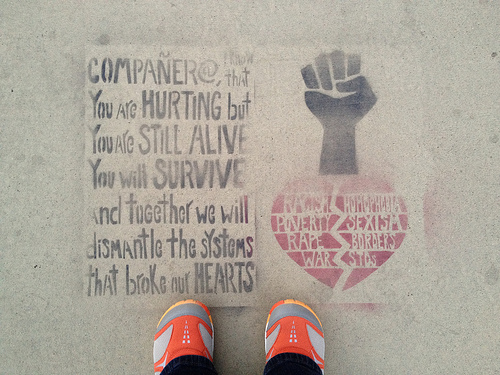
together we will dismantle the systems that broke our hearts

Not long ago, I joined up with a motley crew of writers desiring to live in a way that proclaims that Jesus is Lord and Caesar is not. Folks are writing this week on the topic of solidarity, and like a good student of liberation theology, I have a number of thoughts on the matter which I can distill to Proximity, Listening, and Humility. I want to position myself near those who are oppressed and hurting like Jesus did, I want to honor their stories, and I want to take cues from them. I learn a great deal from Christena Cleveland (please stop whatever you are doing and read this series now), Shay Kearns, T.F. Carlton, Sarah Moon, Mihee Kim Kort, and D.L. Mayfield.

And if you missed them the first time around, I've touched on similar themes before:

waging peace: conflict, christian unity, & power
sacrificing privilege on the altar of grace
all oppression shall cease: a feminist theology of power
a church disarmed 
tragically hip: privilege & the emerging church
to love is to serve is to liberate

What does solidarity look like in your life? How do you need it? How do you demonstrate it? How does the Church practice this well and poorly? How can we do it better? How does Jesus model solidarity with those who are outcast and oppressed?

Related Posts Plugin for WordPress, Blogger...