Friday

christians, stop shooting our wounded


[This post explores the landscape of recovery and the fallout from abuse.]


We talked about sex in the summer camp dining hall. It was staff orientation, and we unpacked consent, abuse, and how virginity is a lousy measure of the purity of one’s heart before God. We deconstructed bad metaphors, exploring the significance of the incarnation and the imago Dei.

She found me later, a young woman who’d been through hell and back. Her courage blew me away.

“Thank you for seeing me,” she said, eyes shining. “Sometimes I feel so invisible.”


WE LOVE TO TALK ON THINGS WE DON’T KNOW ABOUT


Our sisters’ and brothers’ blood cries out from the ground. Others bear unfading scars from sexual, psychological, physical, emotional, and spiritual abuses, suffered even at the hands of those claiming Christ’s name.

We may not have hearts to understand, but we serve up solutions all the same. Do you want to be well? we ask. Take your mat and walk!

Our faith is strong! We believe in miracles, authority, and happily-ever-after. We are full of advice.

Ain’t it like most people? I’m no different
We love to talk on things we don’t know about

We want to be like Christ, desperately. But our Great Physician has scars of his own, and too frequently, we are the ones with blood on our hands.


IT TEACHES YOU SHAME


“Abuse teaches a lot of terrifying lessons. It teaches you that your body is not your own. That your hopes and feelings are irrelevant. It teaches you shame. It teaches you to be bullied under the guise of protection. It teaches you to blame yourself for the harmful actions of others. It teaches you that some people are allowed to hurt those less powerful than them. It teaches you to be afraid of sex, anything that might lead to sex, and even being alone with certain people…
All I really needed to hear but never once heard in my church growing up was that nobody is allowed to hurt me; that I have value and worth that is distinct from what anyone did to me and distinct from anything I do or don’t do; that I had agency and autonomy; that I had the right to say ‘no’; that my ‘no’ should be respected; that I also have the right to say ‘yes’ or actually make decisions for myself; that if somebody tries to pressure or guilt me into doing what they want me to do, whether that somebody is a jerk I’m dating or the leader of my youth group, then I should walk away and never look back.” (Laura Gaines)

“Spiritual abuse survivors are like any other abuse survivors. You have to meet them where they are comfortable. Some have serious PTSD issues and can’t deal with anything that might be related to their old church, including any talk of Jesus, God, church, or Sunday Services. You also have to realize that for a lot of these people, they will never go back to church, just like alcoholics don’t go into bars or drug addicts don’t hang around their old druggie friends any more.
We had faith. Things didn’t work. We were told that we didn’t have enough faith, and we got into a horrible downward spiral of self-hate and loathing because we just weren’t good enough. Because if we were good enough, things would have turned out differently.” (Deb Fuller)

Our churches have, at times, been toxic places for survivors of abuse. We have not been safe people, and we’ve squandered the trust of far too many.


BUT MY CHURCH ISN’T LIKE THAT


“If we want our churches and Christian spheres to be safe, we need to stop self-justifying and defending… We are so determined to prove ourselves right or righteous that we steam roll over people’s experiences and stories, indeed their lives, in order to be the right ones. Allow yourself to be seen as wrong; take the blame, the responsibility. Sit with the pain, the being, the story of another without trying to prove that ‘We aren’t / I’m not like that.’ That is the only way people will feel safe, heard, or stop feeling like ‘Things aren’t ever going to change. I don’t belong here. I’m too broken.’” (Aaron Smith)

As members of one Body commanded to love our neighbors as ourselves, we are each other’s keepers (in a non-coercive, I-got-your-back sort of way). Dysfunction and abuse cannot merely be contained locally; they must be dismantled and repented of systemically. We are one Church.

But instead of walking each other through the valleys, we assume authority and are not always worthy of it. We weaponize scripture, wielding it against each other. Sometimes even our helping hurts, and our good intentions bear rotten fruit. Meaning well matters little in the wake of the pain we’ve caused, made light of, or turned our backs on.


“Forgiveness is a process in many cases; it didn’t just happen overnight for me or at the urging of others telling me to forgive. .. And a person isn’t flawed because they are working through it still. ‘You’re only hurting yourself by not forgiving.’ As if the person who has been abused doesn’t understand the weight of what they carry. I think most know. The comment is insensitive to someone’s healing process.” (Anonymous)


SURELY HE TOOK UP OUR PAIN


The Man of Sorrows, familiar with suffering, knows what it is to be forsaken and abused. Jesus was killed by oppressive religious and political authorities, and he taught his followers to set aside power and weep with those who weep.

Can we put away false gospels, easy answers, and defensiveness and grieve together for a while?


“Do you think a survivor is too angry about her abuse? Unless she’s personally threatening you, it’s time once again to get over yourself and listen. Discern the source of that anger. I cannot emphasize this enough: at no point do you ever possess the right to tell a marginalized person how to react to her marginalization…When you dismiss our anger at abuse, you dismiss the validity of our experiences, and that is itself an abusive deed. This isn’t about you.” (Sarah E. Jones)

“People need to understand that emotional manipulation and abuse are very painful, and it’s not something you just fix with a few ‘open and honest’ conversations. It’s something that takes a lot of time to heal before reconciliation is even on the table, because every attempt at reconciliation makes you vulnerable, and restoring the trust and the strength necessary to do that is not a mere act of will.” (Chris Attaway)


RADICALLY, SUBVERSIVELY SAFE


As Christians, we like to talk about cultivating a radical, dangerous faith that sets the world ablaze, but are we getting ahead of ourselves? What if the most radical thing we could do was to create safe communities?

What if we practiced radical hospitality and radical humility, allowing the messy, uncomfortable work of healing to play out in our midst?

What if among us the last really were first? What if Christians actively subverted the power structures that favor some perspectives and people over others? What if the Church harbored and honored those who are hurting, doubting, struggling, or oppressed over those most frequently seated at the head of our tables: the sure, strong, educated, beautiful, male, married, straight, white, wealthy, healthy, or righteous?

What if we repented of the ways we were complicit or unseeing to abuses of people and power among us? Could loving people well in the midst of their pain be the radical way of Jesus?


SHUT UP. LISTEN. RESPOND WELL.


“It’s actually pretty simple. Don’t use your position of authority to manipulate people for personal self-aggrandizement. Don’t turn honest personal questioning, confession, [or] seeking into a petty power play. When someone seeks succor or absolution or clarity, refrain from blame, shame and humiliation. You know, Christian stuff.” (Pat S.)

“Really LISTEN to their stories. Validate. Show compassion. Whatever you do, don’t act like you have all the answers, and surely if they’ll ‘just’ do x, y, and z everything will be all sunshine and roses again, forever and ever, amen. LISTEN to their stories. Don’t judge. Don’t minimize. Don’t fix. Just listen. Be patient with them. Just like any other type of healing, it’s a process, not an overnight thing.” (Anna Caltagirone)

“I can attest to the war wounds of spiritual abuse. The best that a Christian can do to relate to me is to remember that my relationship with God is a highly personal, fragile, and private thing. Respect my process. Don’t push your agenda. Trust me in the hands of the God you follow.” (Liv Weston)

“I keep drifting back in my mind to the time that was all happening, it would have been so validating if someone had listened. And in the next step stood up and said, ‘This isn’t right. What you’re doing is wrong.’ Not one person did.” (Elizabeth Bennet)

“I want someone to look at me and listen to the horrors I have endured, and instead of telling me that all would be well if I just forgave my abuser – instead of telling me to pray…to seek healing, as if I haven’t spent years doing just that – instead of telling me that maybe what I suffered wasn’t actually abuse -just listen, hear me, and say, ‘What happened to you should not happen to anyone. Come inside and sit with us for a while.’” (Becca Rose)


BIRTH SOMETHING BETTER


We can’t be faithful as a Church and continue to side with the powerful, shoot our wounded, or paint all of our critics as haters. We who believe in grace, humility, and resurrection are called to birth something better than what we have right now.

So raise a glass to turnings of the season And watch it as it arcs towards the sun And you must bear your neighbor’s burden within reason And your labors will be born when all is done
The Truth is rarely shiny, but he shows up in the midst of our darkness, blessing the merciful and the mourning. Repenting and walking the way of the Wounded Healer who breaks bread, washes feet, and binds up the broken hearted, we’ll choose love and liberation over coercion, callousness, and business-as-usual. We’ll bear each other’s burdens, asking the privileged—not the abused—to offer the first fruits of repentance.

We want to be well together.

Sunday

a voice is heard in Ramah


Drew G.I. Hart: Pain Medicine: Trayvon, Simon of Cyrene, and Jesus
Black Youth Project: 100 Young Black Activists Respond to George Zimmerman Verdict 
Enuma Okora: The mother of all grief (Washington Post, On Faith)

Christ have mercy. Kyrie eleison.

Thursday

a grand canyon of light


I love my country
By which I mean
I am indebted joyfully
To all the people throughout its history
Who have fought the government to make right
Where so many cunning sons and daughters
Our foremothers and forefathers
Came singing through slaughter
Came through hell and high water
So that we could stand here
And behold breathlessly the sight
How a raging river of tears
Is cutting a grand canyon of light


{from Grand Canyon by Ani DiFranco. Happy Fourth, friends.}

Tuesday

on solidarity

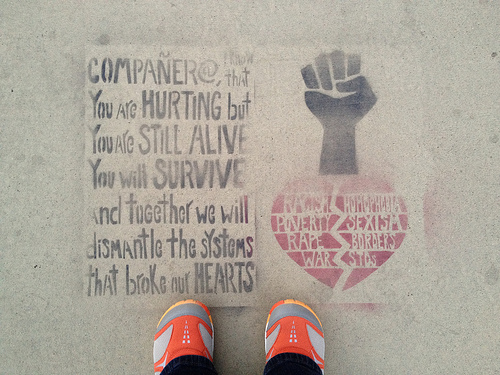
together we will dismantle the systems that broke our hearts

Not long ago, I joined up with a motley crew of writers desiring to live in a way that proclaims that Jesus is Lord and Caesar is not. Folks are writing this week on the topic of solidarity, and like a good student of liberation theology, I have a number of thoughts on the matter which I can distill to Proximity, Listening, and Humility. I want to position myself near those who are oppressed and hurting like Jesus did, I want to honor their stories, and I want to take cues from them. I learn a great deal from Christena Cleveland (please stop whatever you are doing and read this series now), Shay Kearns, T.F. Carlton, Sarah MoonMihee Kim Kort, and D.L. Mayfield.

And if you missed them the first time around, I've touched on similar themes before:

waging peace: conflict, christian unity, & power
sacrificing privilege on the altar of grace
all oppression shall cease: a feminist theology of power
a church disarmed 
tragically hip: privilege & the emerging church
to love is to serve is to liberate

What does solidarity look like in your life? How do you need it? How do you demonstrate it? How does the Church practice this well and poorly? How can we do it better? How does Jesus model solidarity with those who are outcast and oppressed?

Sunday

the glory of God is the human person fully alive


"For the glory of God is the human person fully alive; and life consists in beholding God. For if the vision of God which is made by means of the creation, gives life to all the living in the earth, much more does the revelation of the Father, which comes through the Word, give life to those who see God." -Irenaeus of Lyon (130-200)

I read that in Common Prayer this morning, and in light of our conversations this week about gnosticism, I couldn't wait to share a bit with you:

The first systematic theologian of the church, Irenaeus lived in a time when Christianity was young and fragile. He was appointed bishop of Lyon and combated the dualistic notion that matter and spirit are entirely separate, with matter being wholly corrupt. Irenaeus insisted that there is nothing inherently corrupt in creation but that humans lost their "likeness to God" through the distortion of sin. That likeness was restored, Irenaeus proclaimed, through Christ, the "second Adam," who corrected the story of the first Adam. In a time when so much of Christianity has been reduced to disembodied doctrine of otherworldly sentiment, Irenaeus' voice rings out like a prophet's.

Taking on our flesh, you have made flesh holy, Lord. Help us to die to our selfish ways and our faithless habits that we may know the fullness of your new creation in our communities as it is in your resurrected body. Amen.
(Shane Claiborne, Enuma Okoro, Jonathan Wilson-Hartgrove)

May our bodies, which bear God's likeness, tell the story that we, too, have seen God.

Friday

on objectification {or, how people aren't objects no matter what they wear}


As hemlines and the heat index rise, so do temperatures of the modesty debates among Christians. 'Tis the season, and nothing says summer quite like barbecue, swimsuits, and a good, old fashioned slut-shame.

What interests me especially is how the language of objectification creeps into these conversations about modesty. Feminists have long rallied against objectification of women in pornography and culture, and in an unexpected plot twist, conservative Christians seem to be jumping aboard the anti-objectification train, too. At first glance, this appears to be a step in the right direction. Yay for diverse coalitions against the idol patriarchy!

But somehow that train always seems to derail somewhere in Gnostic Territory, a grim and fearsome wasteland. Wallala leialala. Do. Not. Want.

I want to talk about what objectification is and isn't, how the premises of these debates are flawed, and how we can reframe this conversation to reflect what we believe about the incarnation. Feminism and Christianity may be strange bedfellows, but together they really can shape a positive counter-narrative to the stifling, demeaning, and heretical ones casting men as feral beasts and women as objects of lust (or scorn) instead of all of us embodied, fully human people bearing the image of God.

We are {created for} so much more than this.

---

Recently, a Christian website put up a much shared video called The Evolution of the Swimsuit: Can Modesty Make a Comeback? In it, Jessica Rey, owner of a one-piece swimwear line, blames the bikini for cultural decline and the dehumanization of women. So scandalous was the first modern bikini, it was modeled by a French stripper! She cites Modern Girl Magazine in 1957 opining that "no girl with tact or decency would ever wear such a thing"--that is, until the sexual revolution and women's movement seemingly sent both out the window. For Rey, women exercising power over their wardrobe, body, or sexuality by donning a two-piece cannot be construed in any sort of positive light. Citing a Princeton study and an article about it, Rey makes this bold claim:

Analysts at the National Geographic concluded that bikinis really do inspire men to see women as objects, as something to be used rather than someone to connect with. So, it seems that wearing a bikini does give a woman power, the power to shut down a man’s ability to see her as a person, but rather as an object.

Firstly, weird use of "inspire" there, but secondly, this power women allegedly have to cause men to dehumanize us is pretty much the worst superpower ever conceived, huh? Rey imbues certain types of clothing with the ability to override men's capacity to see women as fully human. The bikini transforms a woman from a person whose body, sexuality, and autonomy are integrated parts of her humanity into some sort of sex kitten patronus existing for male service and fantasy--and it's her own damn fault. The weak-willed man (and they're all weak according to this narrative) is helpless against this overwhelming swimsuit-induced urge to define a woman entirely by her body parts and his own projected desire.

WHAT. This is an astoundingly low view of masculinity, and it's also the same sexist woman-as-vixen/Jezebel/temptress trope that folks have been peddling ever since Eve tasted the fruit in the Garden of Eden.

I couldn't find the original studies to read, but that National Geographic article mentions a few details Rey left out: the sample group included just twenty-one men, some of the photos the students reacted to were of headless torsos and breasts (not women with faces), and the men who seemed to objectify those disembodied images also "scored higher as 'hostile sexists'—those who view women as controlling and invaders of male space."

It doesn't exactly read like the moral mandate to ban the bikini like Rey seems to suggest. The Daily Princetonian, interviewing the study authors, reported:

Study participants were also asked to fill out a survey designed to measure how sexist they are. The researchers found that when the men whose surveys indicated that they were the most sexist saw the pictures of women in bikinis, they were least likely to activate a part of the brain associated with thinking about people’s minds and thoughts, Fiske said.
“I think [the study] does relate to the effects of having pornography and sexualized images of women around and in the media because they spill over into how people treat women in general,” Fiske said, adding that these images may dehumanize women and encourage men to see them as objects. “You have to be aware of the effect of these images on people,” Fiske explained. “They’re not neutral. They do have an effect on how people think about other women.” 
Cikara said she agreed that the reactions observed in the study might be a consequence of society’s emphasis on sexualized female imagery. 
“This research can certainly help to further our understanding of the effect of sexualized women, whether in advertising or in the office,” Cikara said, adding that “men can totally override this response.” She noted that men do not look at their wives or sisters in the same way that they look at a sexualized image of a woman on an advertising billboard.

Now we're getting somewhere. While Rey argues that the bikini causes men to objectify women, implying both feminine blame and a female onus to change men's minds and their dehumanizing behavior (assumptions that are a quick jump to disturbing "she asked for it" rape apology), the Princeton study's authors suggest instead that objectification is rooted in pornography and sexism, and that men are in fact empowered to control their own gaze and action, a remarkably different conclusion than Rey's.

From The Princetonian again: "Fiske said the results indicated that some men may objectify or dehumanize partially clothed women, though further research is needed to confirm these findings." 

*Some men* may objectify partially clothed women. *Further research is needed.* to confirm these findings.

I won't jump on the "Bikinis Are Bad" bandwagon just because researchers flashed images of boobs to a few Princeton co-eds whose brains activated "regions associated with objects or 'things you manipulate with your hands.'" As Jonalyn Fincher argues, that can certainly be seen as a natural responseSexual attraction is hardly indicative of viewing people as objects, and desire is something distinct from objectification. 

Desire says, I want youObjectification says, I want that. 

Sexualized and pornographic images can cast women as objects in a way that an actual woman in a bikini on the beach does not replicate AT ALL. Objectification treats people as tools existing for the pleasure or utility of others. It reduces people to their body parts and appearance, denying their agency, autonomy, and personhood. Christians mistakenly conflate sexual desire with objectification in these discussions, but that betrays a gnostic suspicion of bodies and a lack of understanding that objectification is rooted not in attraction (or sexiness) but the commodification of women's bodies and sexuality.

[Edited to add: Attraction and a temptation to objectify fall along a spectrum that these heteronormative modesty debates fail to acknowledge. As I unpack harmful assumptions implicit in these discussions, I want to recognize that LGBTQ people and attractions (and female desire in general) are generally rendered invisible in these conversations, and that's not okay either. Objectification denies the imago Dei intrinsic to all of us: male, female, queer, gay, straight, and otherwise.]

Sexuality is an integrated part of our humanity even if we are celibate and no matter how we're dressed. It's pornography that can divorce sexuality from humanity, but strangely, so does much evangelical Christian teaching, especially aimed at single people and teens. We've falsely elevated spirit over flesh, misunderstood attraction as lust, and expected something akin to asexuality from unmarried Christians instead of wrestling honestly with what it looks like as individuals and communities to honor God and one another with our sexuality (even if we aren't having sex).

We might disagree on the appropriateness of certain outfits in certain settings, but the choice to wear sexy clothes (something that will always be culturally and personally relative) is never an invitation to view a person as an object. Can we maybe also stop projecting our preferences and prejudices onto people who don't share our faith? A million factors play into how we present ourselves, but dressing to receive sexual attention is still not asking to be seen or treated as a thing instead of a person. A sexual person (and we're all sexual people) is still and always a person.

Clothing and people do not send "Objectify me!" messages, and presenting oneself as female, attractive, or even sexy does not compromise anyone's humanity. Gnosticism, not Christian orthodoxy, casts suspicion and shame on bodies and sexuality, and it was struck down as heresy by the Church long ago. The God who made our bodies called them good and the Incarnation, in which God became flesh, further affirm the value of embodied life.

Women are people; we don't use our "powers" to cause anyone to dehumanize us. Men are people, too, capable of taking "every thought captive" and refusing to let pornography be the lens through which they relate to others. None of us is defined by desire, appearance, sin, or anyone's approval; our intrinsic, unchangeable worth stems from being made in the imago Dei.

Some will objectify a woman no matter what she wears; a cute one-piece, like those in Rey's swimwear line, is unlikely to make a difference to anyone who is predisposed to disrespect women (like the "hostile sexists" in the study). It's sad that Rey's video serves to normalize rather than challenge objectification and shame, but it's deeply troubling that she blames women for men's sexual brokenness. Upholding dignity (as Rey argues for) is a worthy goal, but if we're arguing and living like men are animals and women are objects, we're practicing the sort of terrible theology that can't get us there. There's not a thing a woman can wear to change a culture that treats her as subhuman.

Christians call this Sin. Feminists call it Rape Culture. Either way, it's the sort of brokenness for which Christ died. Resurrection sets brokenness aright, and as Christians, we too are called to be people who push back the effects of the Fall. We can't shrug our shoulders about the inevitability of sin and objectification when we worship a God who raises the dead and breathes new life from ash. When the world is not as it should be, we kick at the darkness 'til it bleeds daylight and commit to growing something better.

But we can't create a faithful alternative to an oversexed, objectifying culture by pathologizing sexuality and imposing modesty rules rooted in bad theology, misogyny, or dysfunction. I believe in seeking to honor God, others, and self, but modesty is something best wrestled with privately and locally and has considerably more to do with humility than swimwear anyway. Universalized rules weigh like chains, and we're not called to bind others to to the specific ways we discern God leading us.

What if instead of reacting against an increasingly sexualized culture with shame, fear, and legalism, we demonstrated what a whole and holy sexuality might look like? What if Christians were known less by our self-righteous spiritualizing and more for being people who understand what it is to be fully human? What if we countered objectification by treating every person we meet with dignity, as one who bears the very the image of God?

Because we do, in swimwear and anything else. We're beloved and fully human, no matter what.

the rarest and purest generosity


Today is the last day of a camp staff training period that lasted nearly three weeks, with Jim working most every waking hour since Memorial Day. We are eating ungodly amounts of dining hall hot dogs, pretzel dogs, bagel dogs, corn dogs, and even, God help us, something that might best be described as a "breakfast dog," and we are hanging in, some moments by a thread.

But! Campers come Sunday and with them daily hours--and a whole weekly day!--off for Jim. And hopefully my own emergence from survival mode and renewed commitment to things like leaving my house, grocery shopping, and preparing healthful food, because I cannot abide the breakfast dog. There are limits, certainly, to what a person can endure for the sake of the Kingdom of God.

My friend D.L. Mayfield posted a link this morning to an article by Jonathan Safran Foer that challenged me, and I wanted to pass it along to you. When I experience stress, I have a tendency to retreat into technology and myself, and parenting unruly preschoolers is nothing if not stressful. But this is not how I want to live this summer or at all:

My daily use of technological communication has been shaping me into someone more likely to forget others. The flow of water carves rock, a little bit at a time. And our personhood is carved, too, by the flow of our habits.
Psychologists who study empathy and compassion are finding that unlike our almost instantaneous responses to physical pain, it takes time for the brain to comprehend the psychological and moral dimensions of a situation. The more distracted we become, and the more emphasis we place on speed at the expense of depth, the less likely and able we are to care.
Everyone wants his parent’s, or friend’s, or partner’s undivided attention — even if many of us, especially children, are getting used to far less. Simone Weil wrote, “Attention is the rarest and purest form of generosity.” By this definition, our relationships to the world, and to one another, and to ourselves, are becoming increasingly miserly. (New York Times)

I want to know, what helps you to pay attention well? What are you enjoying or looking forward to this summer? Are there disciplines or boundaries that help you to stay focused and engaged? What memories endure from your own childhood summers? How do you keep things simple and fun for yourself, your kids, or your family this season?

the mantle


Her heart cried for him to assume the mantle
of Spiritual Head of the Household,
her faith as strong as her desires were specific.
Although speaking the things of God
was her first language, he was a private man of careful words.
If he wouldn’t initiate the family devotions she craved,
they would have none.

Of quiet faith, he led off-stage, dish towel or mower in hand.
Humble hard work was his hallmark, and she led by example, too,
in disciplines spiritual and faith like a child.
She believed there no leaders between them,
but I saw two, alone.

The Christ-Way is not gendered; aren’t all called to follow first?
To lead we bow low, without spotlight or script. 
Different kinds of service and the same God at work. 
Gifted and graced by a Spirit of freedom, 
teaching and learning, we practice as one.

Can we pray? she asked, initiating. And he did, and we did, as a family,
like she’d wanted all along. Some prayers bear fruit in decades’ time, and
we are the ones we’ve searched for all the while.
Related Posts Plugin for WordPress, Blogger...